Hermit crabs are not true crabs. Their long, soft, curled abdomen has no armour of its own, so they tuck it into an empty snail shell and carry the shell around as a portable home. Only the head, claws and front legs show, and one claw is usually larger so it can plug the shell opening like a door.
There are around 800 species. Most are 0.5-4 inches (1-10 cm) long, but the coconut crab, a land-living hermit that gives up shells as an adult, grows a leg span of 3 feet (1 m) and is the largest land invertebrate on Earth.
As a hermit crab grows it must find a bigger shell, and a crab will inspect and try on several before choosing.
Hermit crabs live in every ocean, from tide pools and sandy beaches down to the deep sea. A few families live on land in the tropics and return to the sea only to release their larvae.
Wherever they live they depend on a supply of empty shells, so they are most common where snails are plentiful.
Hermit crabs are scavengers that eat almost anything: algae, dead animals, bits of plants, plankton and small invertebrates. Some filter food from the water with their feathery antennae.
When a good empty shell appears, hermit crabs sometimes line up by size and swap shells one after another in a chain, each crab moving into the shell the one ahead has just left.
Many species carry sea anemones on their shells. The anemone's stings protect the crab and the anemone gets scraps of food, and a crab moving house will often coax its anemone onto the new shell. Hermit crabs are social, curious and surprisingly long-lived; some have reached 30 years in aquariums.
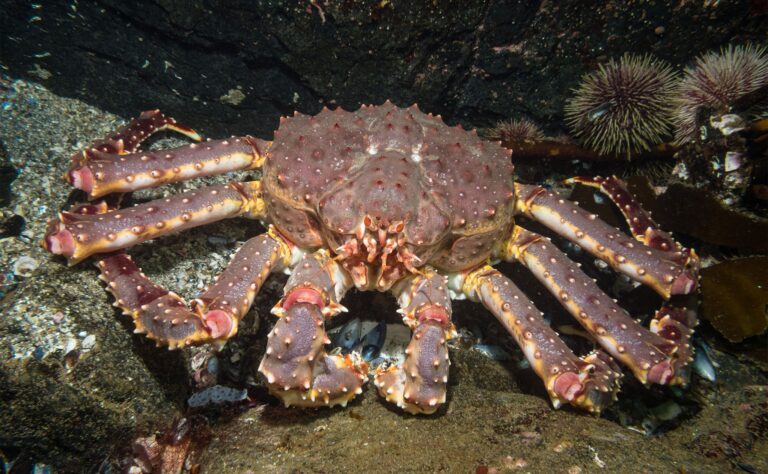
Hermit crabs make up the superfamily Paguroidea, with about 800 species in several families. They are more closely related to king crabs and squat lobsters than to true crabs, and king crabs are thought to have evolved from hermit crab ancestors.
Most species have not been assessed by the IUCN. Shell shortages caused by shell collecting and plastic litter, which crabs mistake for homes, are growing problems on some beaches.