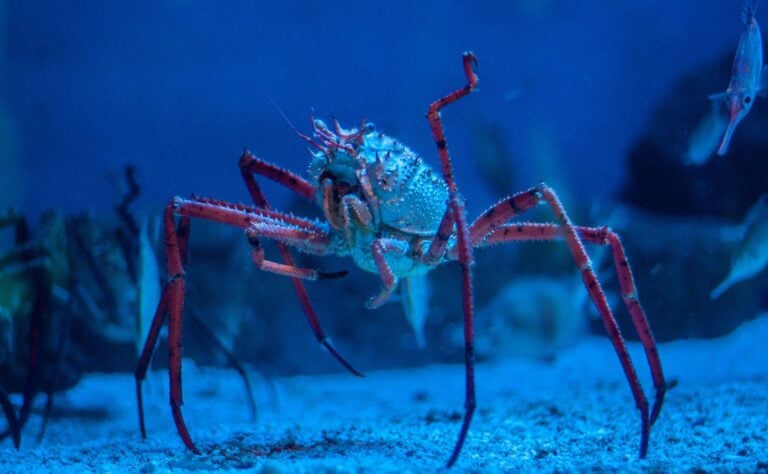
Decorator crab is a name for dozens of species of spider crab that dress themselves up to hide. Most have a shell 1-4 inches (2.5-10 cm) across and long, thin legs.
Their secret is a covering of tiny hooked bristles on the shell and legs, which work like Velcro. The crab snips pieces of sponge, seaweed, hydroids or even small anemones with its claws and presses them onto the hooks, where they take hold and keep growing. A well-decorated crab is almost impossible to spot until it moves.
Some species choose stinging or bad-tasting decorations on purpose, so they are protected as well as hidden.
Decorator crabs live in shallow seas around the world, from tide pools and kelp forests to coral reefs. They are most common on rocky bottoms and reefs where there is plenty of living material to borrow for camouflage.
They are omnivores, picking at algae, sponges, small worms and other little animals, and scavenging whatever scraps they find. Some species nibble on their own decorations when food is short.
Decorator crabs move slowly and rely on staying unnoticed rather than running away. When a crab molts, it often carefully transfers its decorations from the old shell to the new one.
Experiments show that crabs match their outfits to their surroundings and change them if they are moved to a new place. Larger, better-armoured species tend to decorate less as they grow.
Decorator crabs are not a single species. They are found across several families of the spider crab superfamily Majoidea, including Majidae, Epialtidae and Inachidae. Familiar examples include the graceful decorator crab of the Pacific coast and the moss crab.
Because there are so many species, most have not been assessed by the IUCN. Their main pressures are the loss of reef and kelp habitats they decorate from.