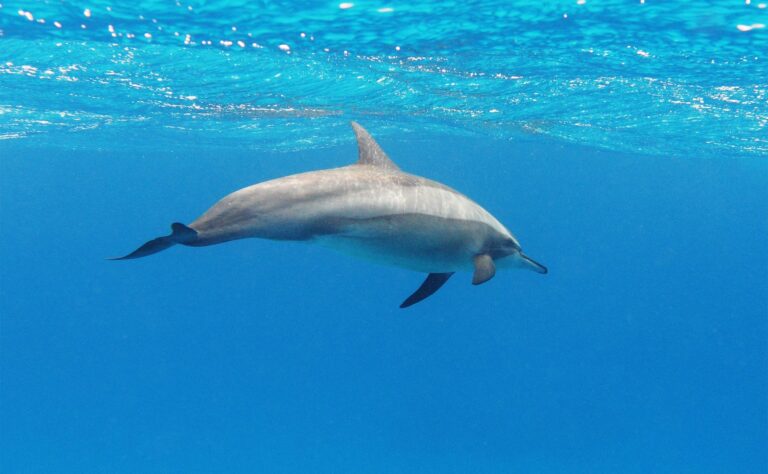
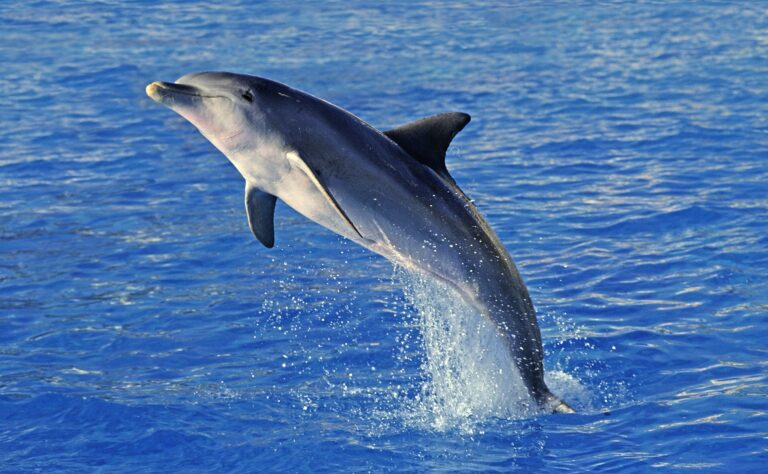
Common dolphins are slender, fast and brightly patterned. Adults are 1.7-2.5 meters (5.5-8 feet) long and weigh 70-135 kg (155-300 lbs). Their colouring forms an hourglass along each side: a dark grey cape on the back, a yellow or tan patch on the front flank, pale grey toward the tail and a white belly, with a dark stripe through the eye.
They have a long, narrow beak and more teeth than almost any other dolphin, with 40-60 small pointed teeth in each row of each jaw. They are built for speed and can reach 60 km/h (37 mph) in bursts.
Common dolphins live around 35 years. Females give birth to one calf every one to three years after a pregnancy of 10-11 months.
Common dolphins live in warm temperate and tropical waters of the Atlantic and Pacific Oceans, as well as the Mediterranean and Black Seas. They are usually found offshore and along the continental shelf, especially where currents and upwellings bring cold, nutrient-rich water to the surface and gather large schools of fish.
They are among the most abundant dolphins in the world, with huge numbers in the eastern tropical Pacific and off the coasts of California, Portugal and New Zealand.
Common dolphins feed on schooling fish such as sardines, anchovies, herring and mackerel, as well as squid. Groups work together to herd fish into tight balls near the surface, then take turns rushing through to feed.
At night they often dive 200 meters (650 feet) or more to feed on fish and squid that rise from the deep after dark. An adult eats about 8-9 kg (18-20 lbs) a day.
Common dolphins are extremely social and acrobatic. They travel in pods of tens to hundreds, and these sometimes merge into superpods of more than a thousand animals that churn the sea surface as they move. They leap, somersault and slap the water, and they love to ride the bow waves of boats and even large whales.
Pods communicate with whistles and clicks and often travel with other species, including tuna and pilot whales.
Delphinus delphis belongs to the oceanic dolphin family Delphinidae. Scientists once split common dolphins into short-beaked and long-beaked species; most now treat them as one species with several regional forms, including a long-beaked subspecies off California and Mexico.
The IUCN lists the common dolphin as Least Concern, with a population in the millions. The Mediterranean population is listed as Endangered after steep declines, and the Black Sea population is also at risk.
The greatest threat is accidental capture in fishing nets, including tuna nets in the Pacific and trawls in the Atlantic. Overfishing of their prey, pollution and underwater noise add to the pressure.