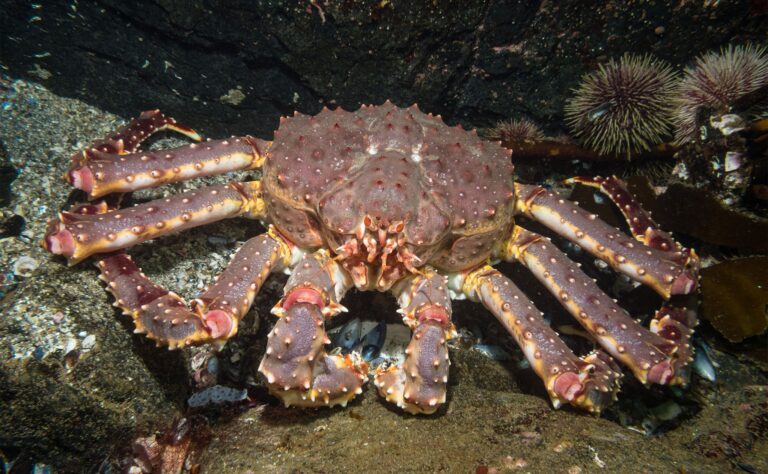
The Japanese spider crab has the longest legs of any arthropod on Earth. From claw tip to claw tip a big male can span 12 feet (3.7 m), wider than a car is long, although the body itself is only about 16 inches (40 cm) across. It can weigh up to 42 lbs (19 kg).
The body and legs are orange with white spots, and the shell is covered in short spines and bumps. The front claws of males are much longer than the walking legs. The legs are surprisingly weak and easily lost, but a crab can live with several missing and regrow them over later molts.
Japanese spider crabs are thought to live as long as 100 years, which would make them among the longest-lived crustaceans.
They live in the Pacific Ocean around the southern coasts of Japan, mostly in Sagami, Suruga and Tosa Bays. Adults keep to the sea floor on the continental slope at 160-2,000 feet (50-600 m), where the water is cold and dark.
In spring they move into shallower water, around 160 feet (50 m), to breed.
Japanese spider crabs are scavengers. They pick over the seabed for dead fish and other animals, shellfish, worms and algae, using their long claws to pull apart whatever they find. In aquariums they are also known to eat plants.
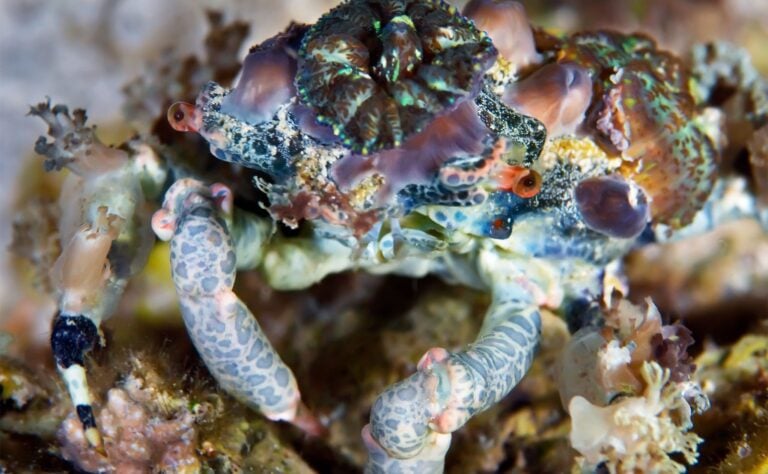
They move slowly and are generally gentle, relying on their size and their camouflage against the rocky bottom. Young crabs decorate their shells with sponges and anemones for extra cover, a habit they share with other spider crabs.
Molting is the most dangerous time in a spider crab's life. Pulling such long legs out of the old shell can take hours, and the crab is soft and defenceless until the new shell hardens.
Macrocheira kaempferi is the only living member of its genus and belongs to the spider crab family Inachidae. The species name honours Engelbert Kaempfer, a German naturalist who travelled in Japan in the 1690s.
It has not been assessed by the IUCN. It is fished in Japan and considered a delicacy, and numbers have fallen in some bays, so the fishery is closed during the spring breeding season and there are efforts to rear young crabs for release.