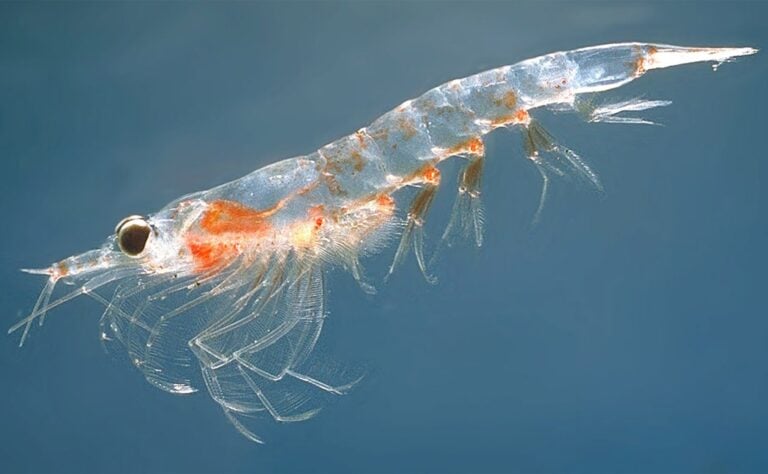
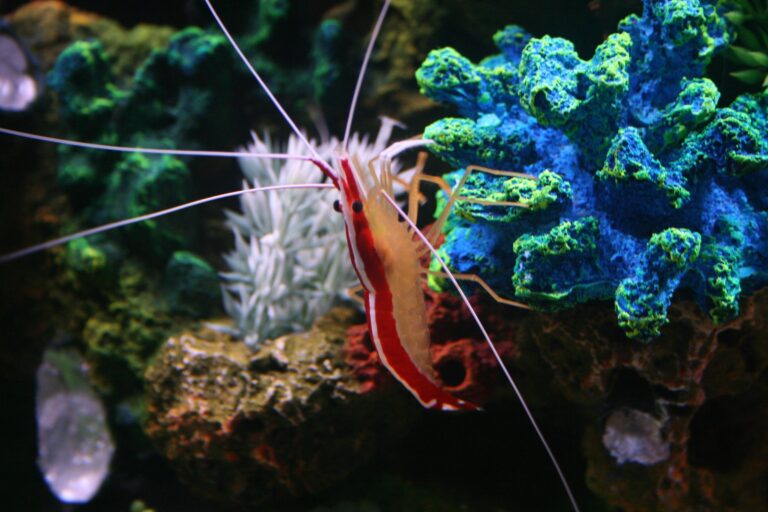
Prawn and shrimp are used almost interchangeably in everyday speech, but to a biologist prawns are a separate group. Prawns have branching gills, claws on three pairs of legs instead of two, and body segments that overlap like roof tiles from front to back. They also release their eggs straight into the water rather than carrying them.
The giant tiger prawn pictured is one of the largest, growing up to 13 inches (33 cm) and 11 oz (320 g), with dark bands across its body and tail. Most prawns are a few inches long, with long antennae, a toothed spine on the head and a fan-shaped tail.
Prawns are short-lived animals, usually surviving one to two years.
Prawns live in warm and temperate seas around the world, with the greatest variety in the tropical Indo-Pacific. The tiger prawn ranges from East Africa through southeast Asia to northern Australia.
Young prawns grow up in estuaries, mangroves and seagrass beds, then move offshore to sandy or muddy seabeds as adults.
Prawns are omnivores that feed on the bottom, mostly at night. They eat worms, small crustaceans, molluscs, algae and dead plant and animal matter, picking through the sediment with their legs and mouthparts.
Prawns bury themselves in the sand during the day and come out to feed after dark. Adults migrate into deeper water to spawn, and a single female tiger prawn can release half a million eggs at a time.
The tiny larvae drift in the plankton for weeks before settling in the shallows, where they grow quickly on the rich food of the estuary.
True prawns belong to the suborder Dendrobranchiata, and most familiar species, including the giant tiger prawn (Penaeus monodon) and the whiteleg prawn, are in the family Penaeidae. Prawns have not been assessed by the IUCN as a group.
They are among the most farmed and traded seafood on Earth. Clearing mangroves for prawn farms, disease in crowded ponds, and the bycatch caught by prawn trawlers are the main environmental concerns.