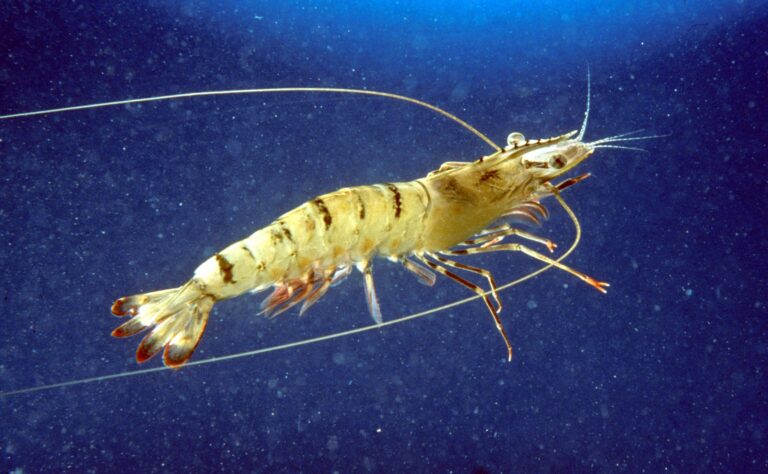
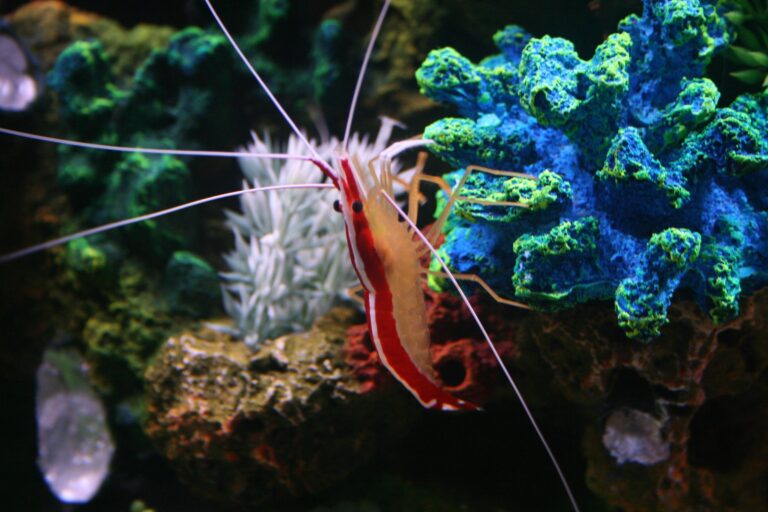
Krill are small, shrimp-like crustaceans that live in enormous swarms and feed much of the ocean. There are about 86 species. The largest and most important, the Antarctic krill, grows to 2.4 inches (6 cm) and weighs about 0.07 oz (2 g); many other species are less than an inch long.
Their bodies are mostly transparent with a reddish tint, and their gills are visible on the outside. Krill carry light organs along the body and can glow, probably to keep their swarm together and to confuse predators.
Taken together, Antarctic krill are one of the most abundant animals on the planet, with a total weight of several hundred million tonnes.
Krill are found in every ocean, from the tropics to the poles. Antarctic krill live only in the Southern Ocean around Antarctica, where in winter the young feed on algae growing on the underside of the sea ice.
Most krill spend their lives in the open sea rather than on the bottom, forming swarms that can stretch for miles and colour the water red.
Krill feed mainly on phytoplankton, the microscopic plants of the sea, which they strain from the water with a basket of bristly legs. They also eat small animals of the plankton and algae scraped from the sea ice.
Krill rise toward the surface at night to feed and sink into deeper, darker water by day to avoid being eaten, a daily journey repeated throughout the oceans. Swarms can contain thousands of krill in every cubic metre of water.
Antarctic krill can live up to six years and, unusually, can shrink when food is scarce in winter, molting down to a smaller body size.
Krill form the order Euphausiacea. The IUCN lists Antarctic krill (Euphausia superba) as Least Concern, but it is a keystone species: blue whales, humpbacks, crabeater seals, penguins, squid and fish all depend on it, and a poor krill year ripples through the whole Antarctic food web.
Krill are fished for fish-farm feed and omega-3 oil supplements under limits set by an international commission, and the loss of sea ice as the climate warms is the biggest long-term threat to Antarctic krill.