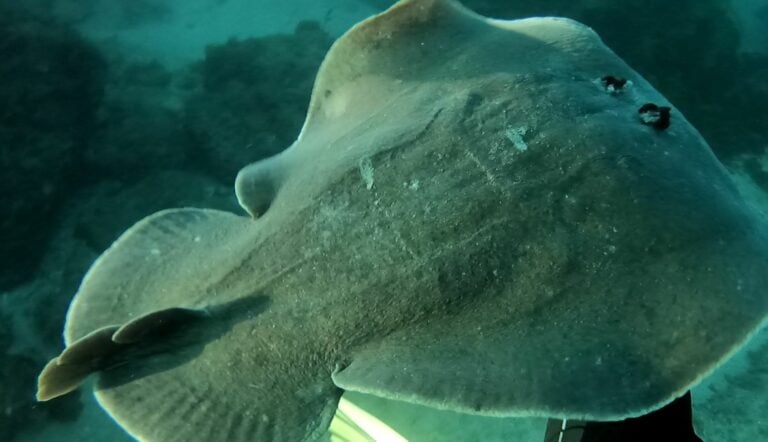
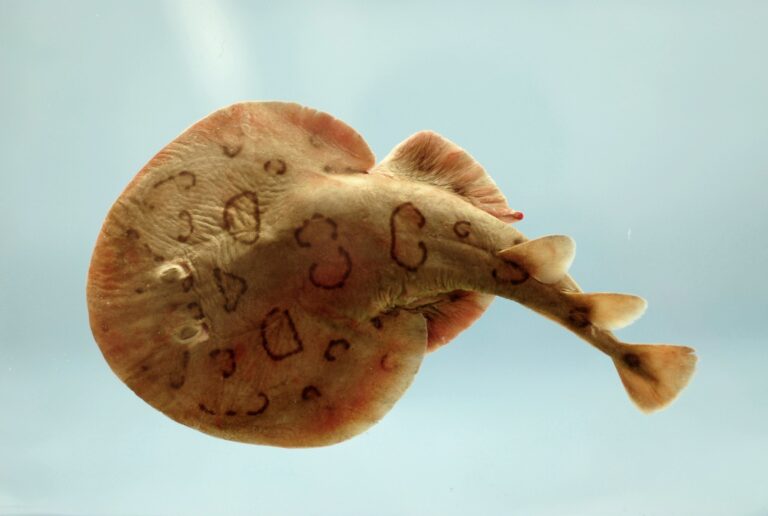
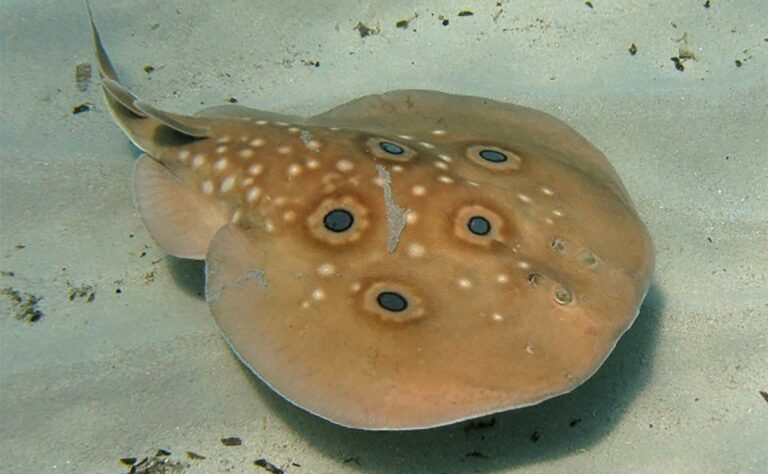
Sleeper rays are small, round electric rays of the Indian and western Pacific Oceans, so named for the sluggish way they lie on the seabed. The Japanese sleeper ray pictured grows to about 16 inches (40 cm) and is reddish-brown above with a soft, scaleless body, a short tail and a single dorsal fin.
Like all electric rays it carries a pair of electric organs in its disc. Its shock of 30-80 volts is strong enough to be painful to a person and to stun the small animals it eats. The eyes are tiny and some species of sleeper ray are nearly blind.
Sleeper rays live on sandy and muddy bottoms from the shallows down to about 650 feet (200 m), from Japan, Korea and China through southeast Asia to India, South Africa and Australia. The Japanese sleeper ray is common around the coasts of Japan and the East China Sea.
Sleeper rays eat worms and other small invertebrates that live in the sand, which they find by touch and electrical sense and suck up with their small mouths.
Sleeper rays are among the least active of all fish. They lie buried in sand for most of the day and move only short distances, relying on their shock to deter anything that bothers them.
Females give birth to live young, usually about five pups, after a pregnancy of around four months.
The sleeper ray family Narkidae contains about a dozen species in five genera. The IUCN lists the Japanese sleeper ray (Narke japonica) as Vulnerable because it is caught in large numbers in bottom trawls off East Asia, where fishing pressure is intense.