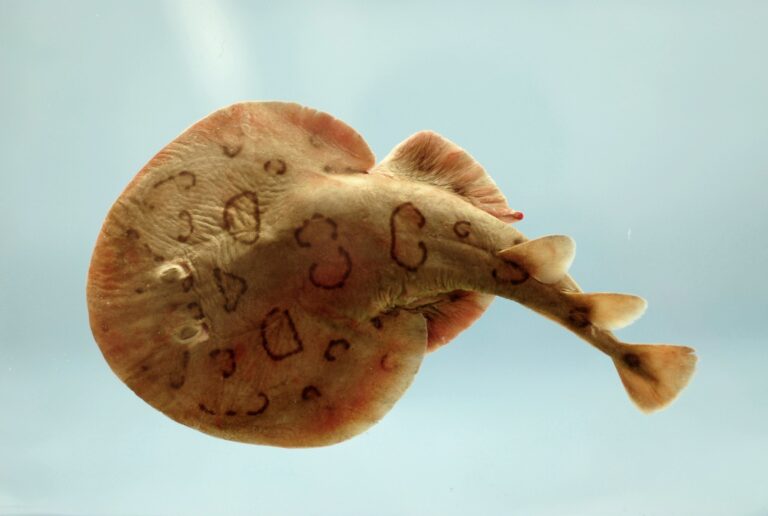
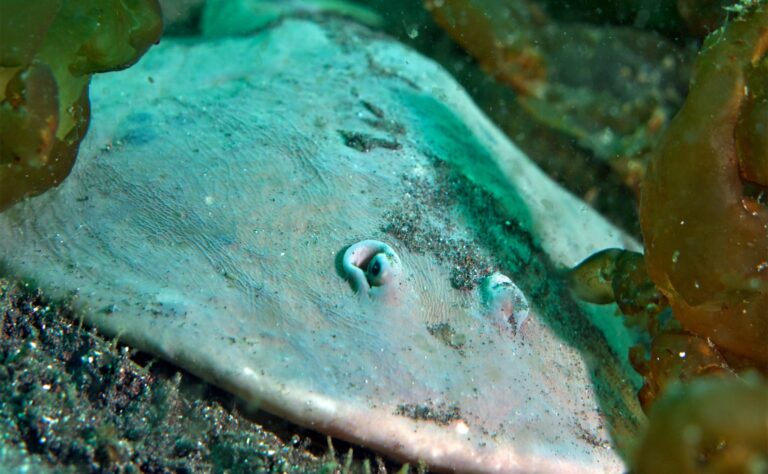
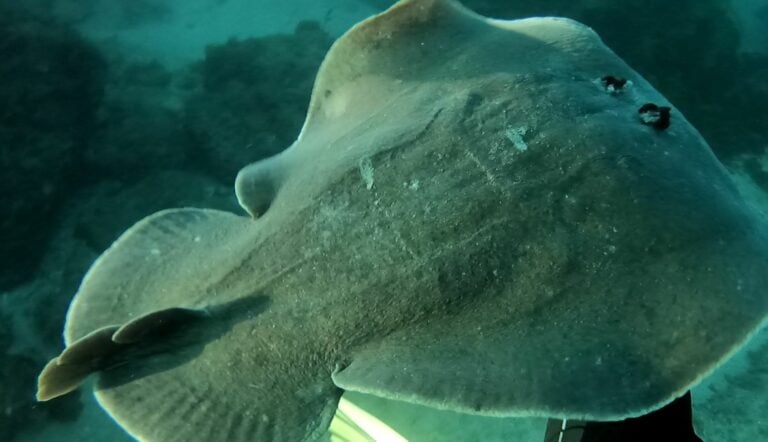
Torpedo rays are the most powerful electric fish in the sea. Two kidney-shaped electric organs, made of stacked cells like batteries, fill the sides of the rounded disc and can fire a shock of more than 200 volts in the largest species. The common torpedo pictured grows to about 2 feet (60 cm) and is marked with five blue eyespots; the Atlantic torpedo reaches 6 feet (1.8 m) and 200 lbs (90 kg).
Their bodies are soft and smooth with a thick, short tail and two dorsal fins. The ancient Greeks called them narke, meaning numbness, the origin of the word narcotic, and the word torpedo comes from the Latin for stiff or numb.
Torpedo rays live in temperate and tropical seas around the world, on sand and mud bottoms from the shallows down to more than 3,000 feet (1,000 m). The common torpedo is found in the eastern Atlantic and Mediterranean; the leopard torpedo in the Red Sea and western Indian Ocean.
Torpedo rays eat fish, including species larger than their own mouths. They ambush prey from the sand or glide over it, wrap it in their disc and stun it with a burst of shocks, then swallow it whole.
They spend the day buried in sand and hunt at night. The shock is used for both hunting and defence, and divers who touch one get a jolt strong enough to make them drop their camera. Roman doctors prescribed standing on a live torpedo to cure headaches and gout.
Females give birth to live young, from a handful to several dozen depending on the species.
The torpedo family Torpedinidae contains about 20 species. The IUCN lists the common torpedo (Torpedo torpedo) as Vulnerable and the Atlantic torpedo as Least Concern; the leopard torpedo (Torpedo panthera) is Data Deficient. Bottom trawling in the Mediterranean and West Africa is the main threat.