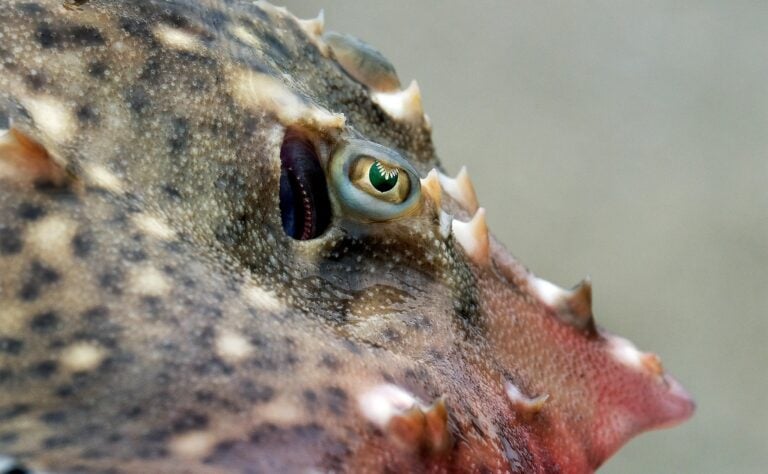
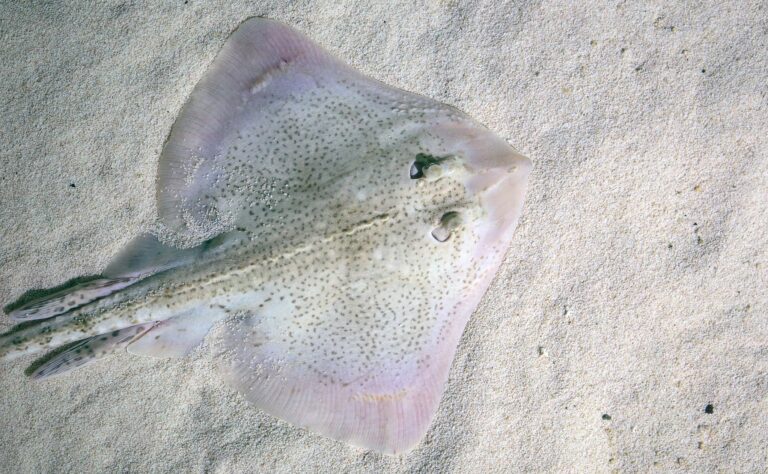
The big skate is the largest skate in North American waters, growing up to 8 feet (2.4 m) long and 200 lbs (91 kg). It is a flattened, diamond-shaped fish with a pointed snout, a long thin tail and two large dark eyespots on its wings, which may fool predators into thinking a much bigger animal is looking back at them.
Skates differ from stingrays in having no venomous spine and in laying eggs rather than giving birth to live young. The big skate's egg cases are among the largest of any fish, up to 12 inches (30 cm) long, and unusually each case can hold up to seven embryos.
Big skates can live for at least 26 years.
Big skates live along the Pacific coast of North America from the Bering Sea and Alaska south to Baja California. They prefer sandy and muddy bottoms in bays, estuaries and along the continental shelf, from the shallows down to about 2,600 feet (800 m), though most live shallower than 400 feet (120 m).
They feed on the seabed, eating crabs, shrimp, clams, worms and small fish such as sand lance and flatfish, which they pin to the bottom with their wings and crush with rows of flat teeth.
Big skates spend much of their time buried in sand with only their eyes and spiracles showing, waiting for prey to pass. They swim by rippling their wings.
Females lay their leathery egg cases, often called mermaid's purses, on the seabed, where the embryos take about nine months to hatch. The young are 7-8 inches (18-20 cm) long at birth.
Beringraja binoculata belongs to the skate family Rajidae. The IUCN lists the big skate as Least Concern. It is caught commercially along the Pacific coast for its wings, and because skates grow slowly and lay few eggs, the fishery is monitored closely.