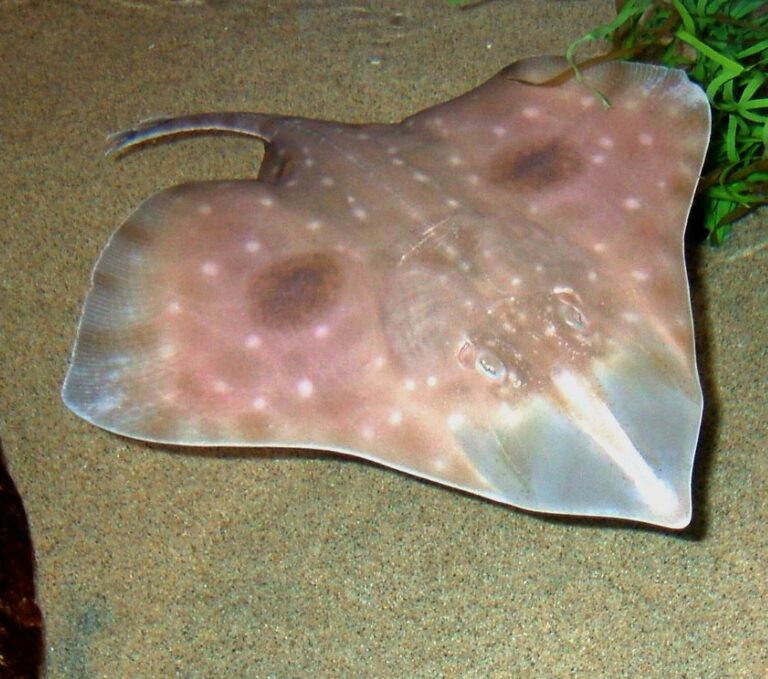
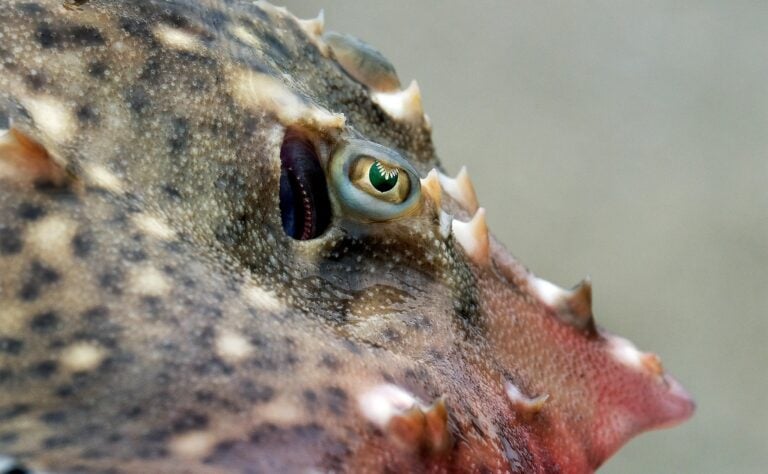
The thornback skate, also called the thornback ray, is the most familiar skate of European seas. It grows to about 4 feet (1.2 m) long and 40 lbs (18 kg), with a diamond-shaped disc, a pointed snout and a long tail. Its sandy back is patterned with dark and pale blotches, and large thorns with swollen bases, known as bucklers, run down the back and tail; big females are covered in them.
Like all skates it has no venomous spine and lays eggs instead of bearing live young. Its egg cases, dark brown with a horn at each corner, are the mermaid's purses most often found on European beaches.
Thornback skates live about 12-15 years.
Thornback skates live in the eastern Atlantic from Iceland and Norway south to South Africa, and throughout the Mediterranean and Black Seas. They prefer sand, mud and gravel bottoms from the shallows down to about 1,000 feet (300 m), and move into shallow bays in spring to breed.
They eat crabs, shrimp, prawns and small fish such as sand eels, gobies and young flatfish, found on the seabed and crushed with rows of small flat teeth.
Thornback skates rest buried in sand by day and hunt at night. Females lay 50-170 egg cases a year in shallow water, and the young hatch after four to five months as miniature adults.
Males have longer, sharper teeth than females, which they use to grip a mate's wing during courtship.
Raja clavata belongs to the skate family Rajidae. The IUCN lists the thornback skate as Near Threatened. It is the skate most often sold for food in Britain and Europe, and although it is more resilient than the common skate, it has disappeared from some heavily fished areas.