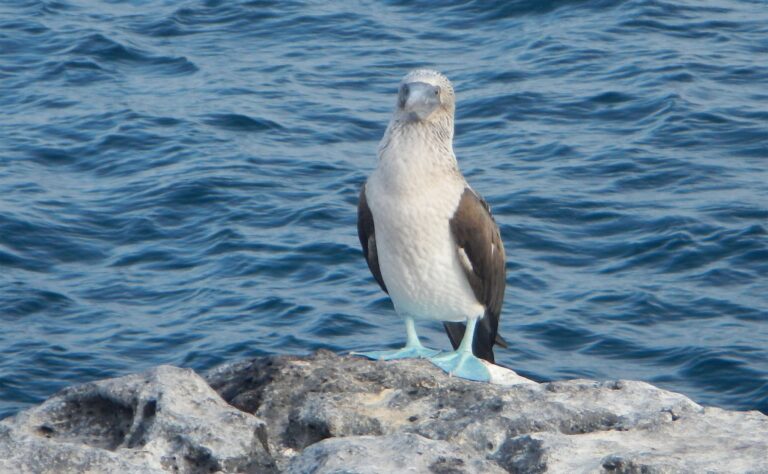
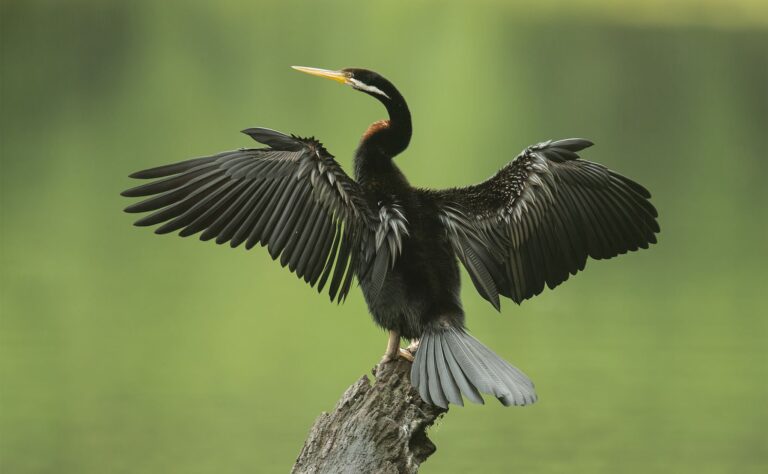
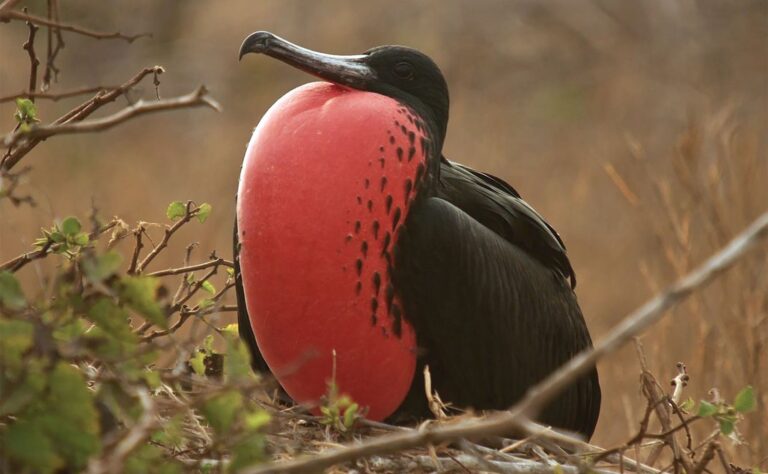
Cormorants are long-necked diving birds with dark, glossy plumage, hooked bills and striking eyes, often turquoise or emerald green. The great cormorant pictured is one of the largest of about 40 species, 31-39 inches (80-100 cm) long with a wingspan of 4-5 feet (1.2-1.6 m) and a weight of 5-11 lbs (2-5 kg).
Unlike ducks, cormorants have feathers that soak up water. This makes them less buoyant so they can dive and chase fish more easily, but it means they must stand with wings outstretched afterwards to dry, the pose that makes them easy to recognise on a post or rock.
The flightless cormorant of the Galapagos has lost the power of flight altogether and has only stubby wings.
Cormorants are found on coasts, estuaries, lakes and rivers on every continent except Antarctica, from Arctic shores to the tropics. Some species live entirely at sea; others, like the great cormorant, are just as happy on inland lakes.
They nest in colonies on cliffs, rocky islands or in trees, often alongside herons and gulls.
Cormorants eat fish, and a great cormorant can take about 1 lb (450 g) a day. They dive from the surface and chase fish underwater, pushing with both large webbed feet, usually in water less than 30 feet (10 m) deep but sometimes down to 150 feet (45 m). Fish are brought up and swallowed head first.
Cormorants fish alone or in groups that drive shoals into the shallows. After feeding they rest in the open with wings spread. They fly low over the water with steady wingbeats, often in lines or V formations.
For more than a thousand years fishermen in China and Japan have trained cormorants to catch fish on a tether, a tradition that still survives in a few places.
The cormorant family Phalacrocoracidae includes the great cormorant, double-crested cormorant of North America, the shags of Europe and many island species. The IUCN lists the great cormorant as Least Concern, and it has increased so much in parts of Europe and North America that it conflicts with fisheries.
Several island species are threatened, including the flightless cormorant (Vulnerable) and the Chatham shag (Critically Endangered), mostly through small ranges and disturbance.