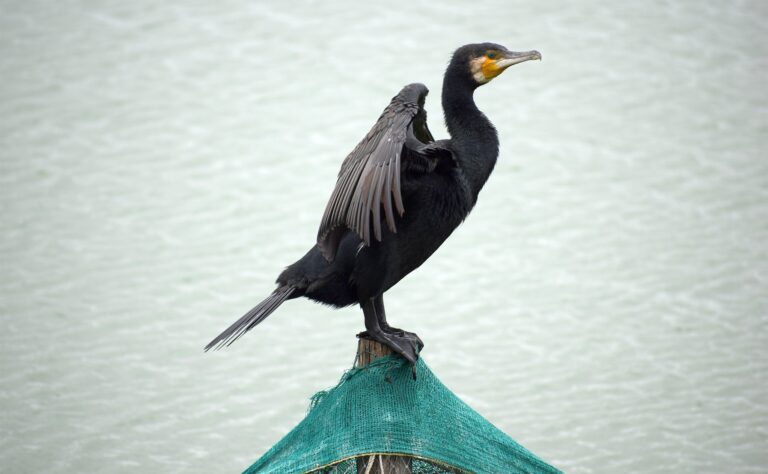
Darters are slim, long-tailed waterbirds with a snake-like neck and a straight, dagger-sharp bill. They are 31-37 inches (80-95 cm) long with a wingspan of about 4 feet (1.2 m) but weigh only 2-3 lbs (1-1.4 kg). When a darter swims, its body sinks below the surface and only the head and neck show, which earned it the name snakebird.
Like cormorants, darters have feathers that get wet, so they can slip underwater easily but must dry their wings in the sun afterwards. A special hinge in the neck lets the head shoot forward like a spear.
There are four species: the anhinga of the Americas, and the African, Oriental and Australasian darters. The bird pictured is an Australasian darter.
Darters live on calm, shallow fresh and brackish water in warm parts of the world: lakes, slow rivers, swamps, mangroves and estuaries. The Australasian darter is found across Australia, New Guinea and parts of Indonesia, and occasionally in New Zealand.
They nest in trees overhanging water, often in colonies with cormorants, herons and ibises.
Darters hunt fish underwater, stalking slowly and then stabbing with the bill. The fish is brought to the surface, flipped into the air and swallowed head first. They also take frogs, water insects, crustaceans and occasionally small turtles and snakes.
Darters spend much of the day perched with wings spread to dry and warm up. They are strong fliers and soar high on thermals with their long necks and tails outstretched, looking like a flying cross.
Pairs build a platform nest of sticks and raise two to six chicks, which are fed partly digested fish.
The darter family Anhingidae has four species, all listed by the IUCN as Least Concern. The Oriental darter of southern Asia is declining and is considered Near Threatened by some authorities. Drainage of wetlands and water pollution are the main pressures.