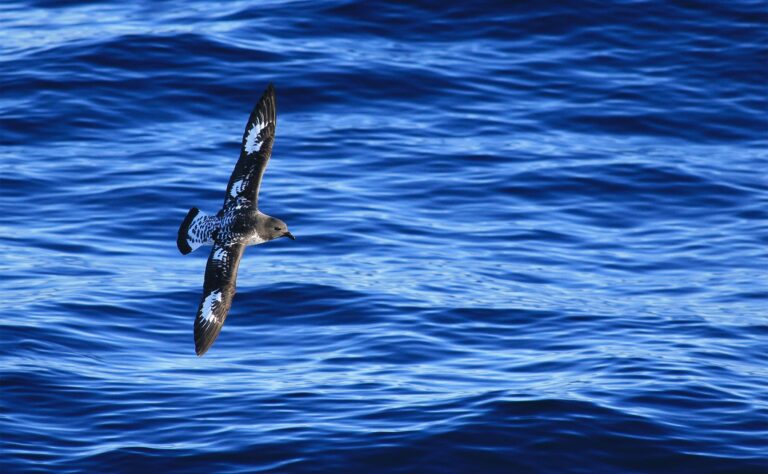
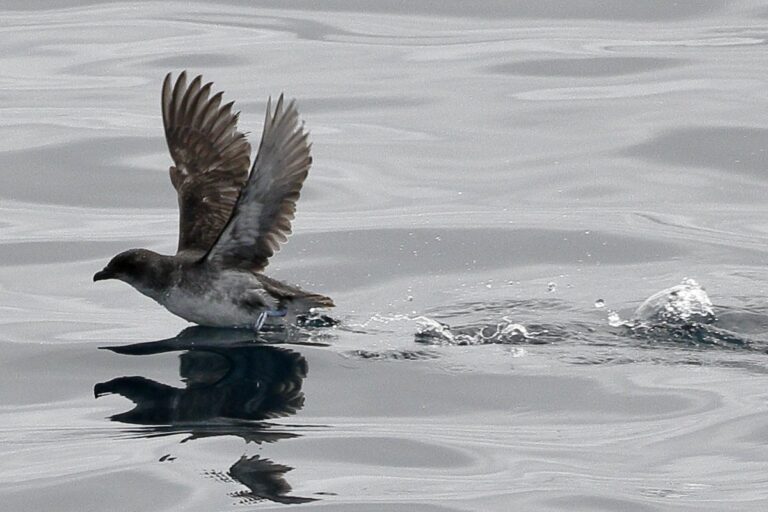
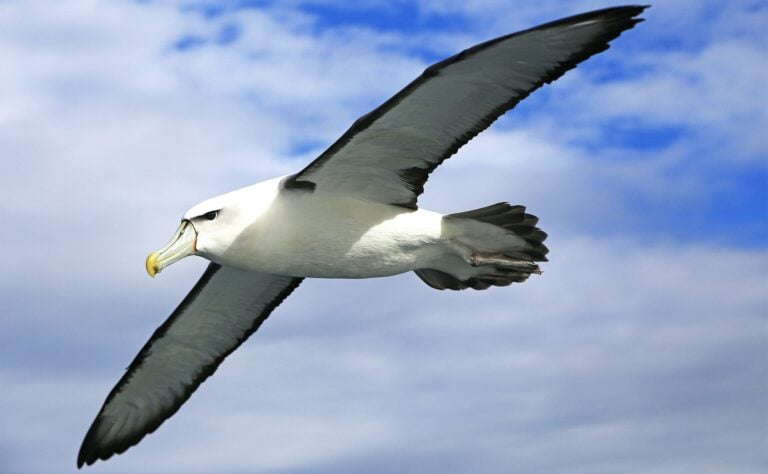
Storm petrels are the smallest seabirds in the world, sparrow-sized birds that spend their whole lives over the open ocean. Wilson's storm petrel, pictured, is 6-7 inches (15-19 cm) long with a wingspan of 15-16 inches (38-42 cm) and weighs just 1-1.5 oz (30-45 g). Most of the two dozen species are sooty black with a white rump.
Their name comes from St Peter walking on the water: storm petrels flutter low over the sea with their feet pattering on the surface as they pick up food. Like all tubenoses they have tubed nostrils, a salt gland and a strong, musky smell.
Wilson's storm petrel may be the most abundant seabird on Earth, with many millions of birds.
Storm petrels are found on every ocean. Wilson's storm petrel breeds in burrows and crevices on the coast of Antarctica and the sub-Antarctic islands, then migrates north to spend the southern winter off North America, Europe and in the Indian Ocean.
They come to land only to breed and visit their nesting colonies only at night.
Storm petrels eat krill and other small crustaceans, tiny fish and squid, and droplets of oil from dead animals, all taken from the surface while hovering. They often gather behind ships and around feeding whales to pick up scraps.
To avoid gulls and skuas, storm petrels arrive at their colonies in darkness, finding their own burrow among thousands by smell. Each pair lays a single egg, very large for the size of the bird, and incubates it for about six weeks.
At sea they flit and bound over the waves like butterflies, staying out in weather that drives bigger birds to shelter, which is how they came to be seen as omens of storms.
Storm petrels were once a single family but are now split into two: the southern storm petrels (Oceanitidae), including Wilson's storm petrel, and the northern storm petrels (Hydrobatidae). The IUCN lists Wilson's storm petrel as Least Concern.
Several species are in danger. The Guadalupe storm petrel of Mexico was wiped out by cats in the early 1900s, the ashy storm petrel of California is Endangered, and the New Zealand storm petrel was thought extinct until it was rediscovered in 2003. Introduced predators on nesting islands and light pollution that grounds fledglings are the main threats.