The American lobster is the heaviest crustacean in the world. Most are 8-24 inches (20-60 cm) long and weigh 1-9 lbs (0.5-4 kg), but the largest ever caught weighed 44 lbs (20 kg) and may have been more than a century old.
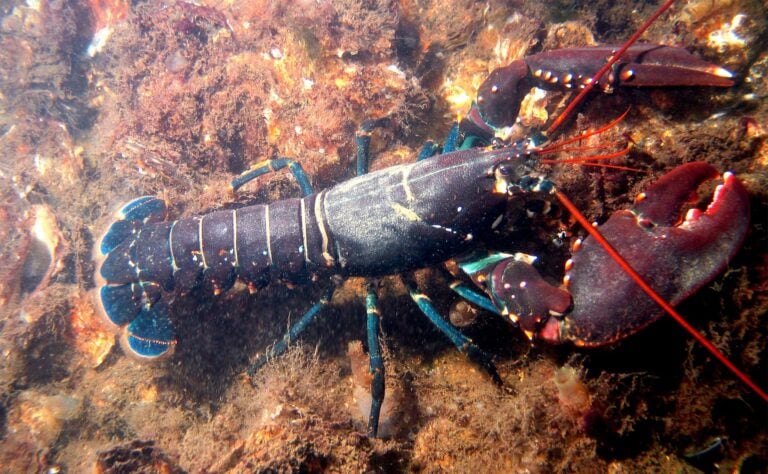
Its two front claws do different jobs: a heavy crusher claw with rounded teeth for breaking shells, and a slimmer cutter claw with sharp edges for tearing. Which side the crusher grows on varies from lobster to lobster. Live lobsters are mottled greenish-brown, which hides them on the seabed; the familiar bright red only appears when they are cooked. Very rarely one is born blue, yellow or even half-and-half.
Like all crustaceans, a lobster grows by molting, climbing out of its old shell and swelling up before the new one hardens. Young lobsters molt many times a year, adults only once every year or two.
American lobsters live along the northwest Atlantic coast from Labrador in Canada south to North Carolina, with the biggest populations in the Gulf of Maine and the Bay of Fundy.
They prefer rocky seabeds with plenty of crevices to hide in, from the shoreline down to about 160 feet (50 m), though some live in deeper water out to 1,500 feet (480 m) on the continental shelf.
Lobsters are scavengers and hunters. They eat crabs, clams, mussels, sea urchins, starfish, worms and fish, and will happily eat a dead animal they come across. They also eat other lobsters, especially freshly molted ones.
Food is crushed and torn by the claws and then ground up by teeth inside the stomach, which work like a set of molars.
Lobsters are mostly nocturnal and spend the day in a burrow or under a rock, coming out at night to feed. They are solitary and territorial and settle disputes with claw-waving displays and short fights.
In some areas they migrate seasonally, moving into deeper water in winter and back toward the shore in summer. A female carries up to 100,000 eggs glued under her tail for 9-12 months before they hatch. Lobsters keep growing throughout their lives and can live 50 years or more.
Homarus americanus belongs to the family Nephropidae, the clawed lobsters, together with its close relative the European lobster. It supports one of the most valuable fisheries in North America, centred on Maine and Atlantic Canada, with strict rules on minimum size and the release of egg-bearing females.
The IUCN lists the species as Least Concern. Populations in the Gulf of Maine have boomed in recent decades while those further south have declined as waters warm, and scientists are watching how the species responds to a changing ocean.