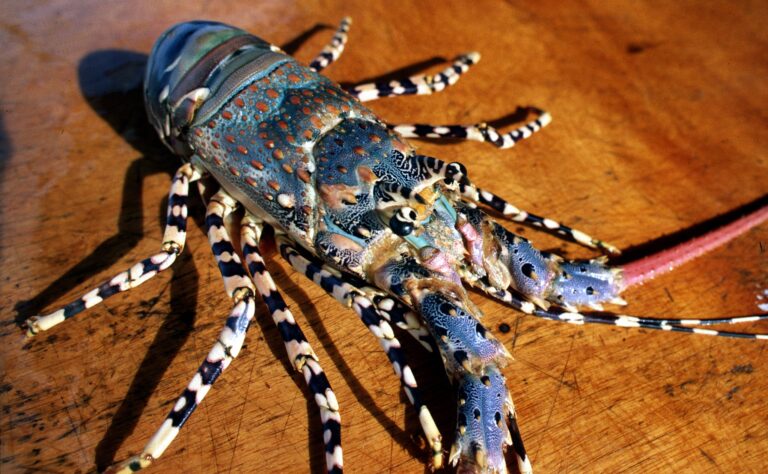
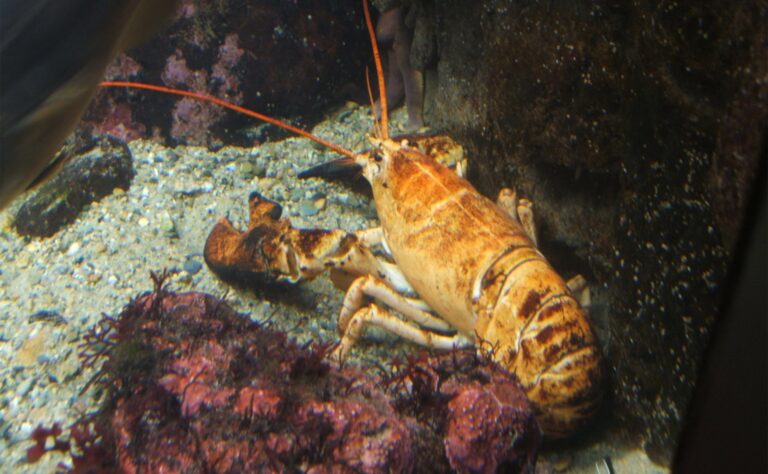
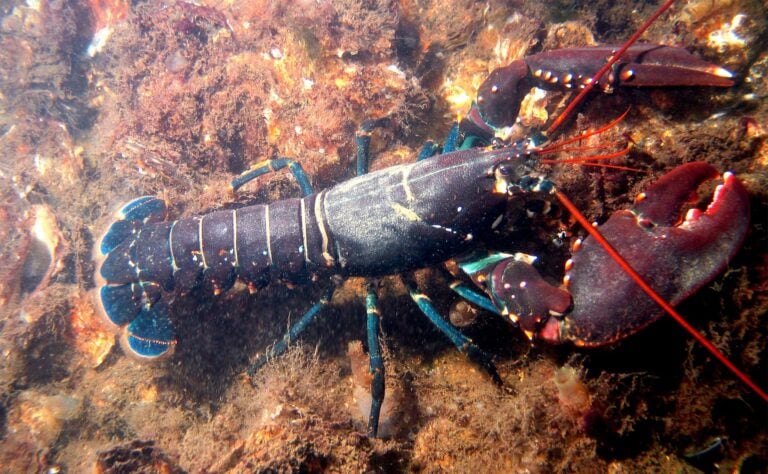
Spiny lobsters have no big front claws. Instead they are protected by a shell covered in forward-pointing spines and by two very long, thick antennae that they can whip at an attacker. The California spiny lobster pictured grows up to 2 feet (60 cm) long and usually weighs 1-5 lbs (0.5-2.3 kg), though a record animal weighed 26 lbs (12 kg).
Their bodies are reddish-brown to orange, and the tail is a thick muscle that powers quick backward escapes. A second, smaller pair of antennae senses chemicals in the water.
Spiny lobsters grow slowly, molting less often as they age, and can live 50 years or more.
Spiny lobsters live in warm and temperate seas around the world, usually on rocky reefs and coral where there are plenty of crevices. The California spiny lobster is found from Monterey Bay south along the coast of Baja California, from the tide line down to about 200 feet (65 m).
Other well-known species live in the Caribbean, the Mediterranean, South Africa, Australia and New Zealand.
Spiny lobsters hunt at night for snails, clams, mussels, sea urchins, crabs and worms, and will eat dead animals. Without claws, they rely on strong jaws and the spiny bases of their legs to break open shells.
By day spiny lobsters pack together in dens under rocks, often several to a crevice with only their antennae showing. At night they walk out across the reef to feed.
Caribbean spiny lobsters are famous for migrating in single file, dozens of animals marching nose to tail across the sand for miles. Spiny lobsters also make a rasping sound by rubbing the base of their antennae against a ridge under the eyes, which startles predators.
Spiny lobsters form the family Palinuridae, with about 60 species in the warm seas of the world. The IUCN lists the California spiny lobster (Panulirus interruptus) as Least Concern. Several other species, including the Caribbean spiny lobster, support large fisheries and are carefully managed with size limits and closed seasons.