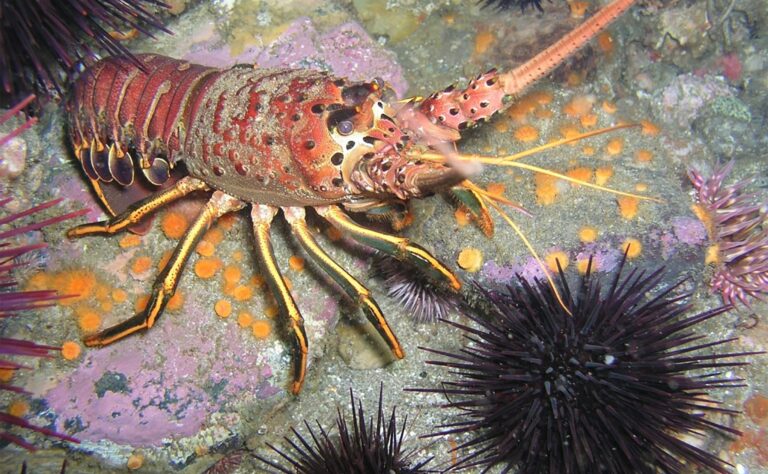
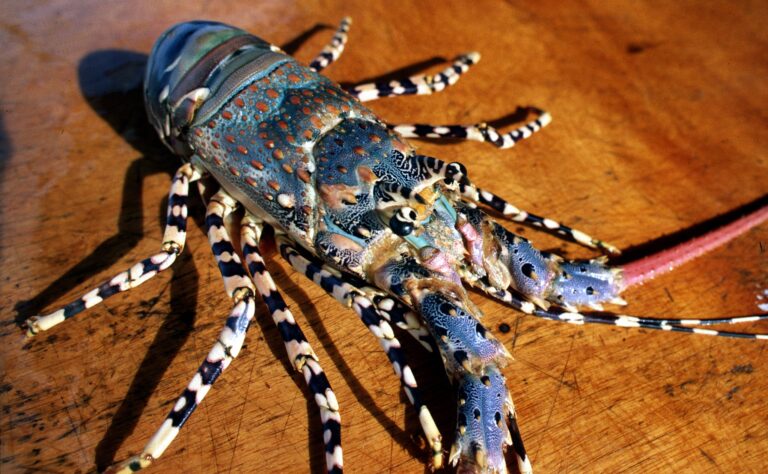
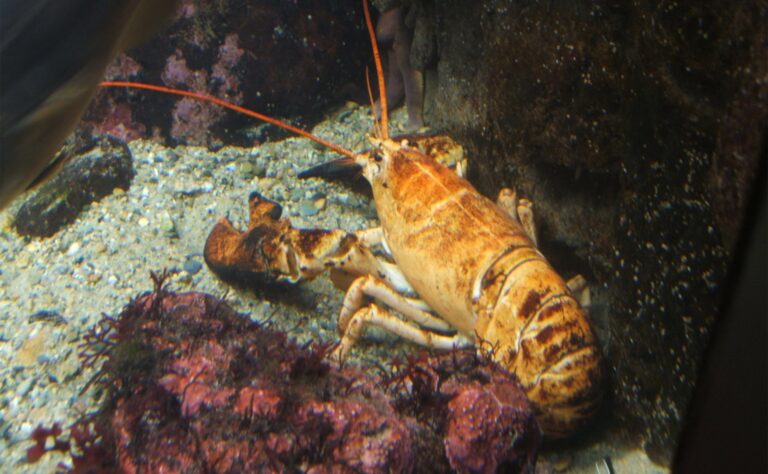
The European lobster is a deep blue animal with creamy-yellow speckles, quite different from the brownish American lobster. It grows up to 24 inches (60 cm) long and 13 lbs (6 kg), though most lobsters caught are 9-16 inches (23-40 cm). Like its American cousin it only turns red when cooked.
It has a large crusher claw and a smaller cutter claw, long red antennae it uses to feel its way in the dark, and eyes on stalks. A lobster can shed a claw to escape and grow a new one over several molts.
European lobsters grow slowly in cool water and can live for 50 years or more. Females carry 5,000-40,000 eggs under the tail for 10-11 months.
European lobsters live in the eastern Atlantic from northern Norway south to Morocco, around the British Isles, and through the Mediterranean and western Black Sea.
They prefer rocky seabeds and reefs where they can dig a burrow under a boulder, from the low-tide line down to about 500 feet (150 m).
They hunt at night for crabs, mussels, clams, sea urchins, starfish and worms, and scavenge dead fish. The crusher claw breaks shells open and the cutter claw tears the meat into pieces.
European lobsters are solitary and strongly territorial. Each keeps a burrow and defends it, and neighbours settle who is boss with displays and short fights that they remember afterwards.
They are most active at night and in summer. In winter they stay deeper and feed less. Young lobsters spend their first few years hidden in burrows and are rarely seen.
Homarus gammarus is one of only three living species of clawed lobster in the family Nephropidae. The IUCN lists it as Least Concern, though it has been heavily fished for centuries around Britain, Ireland, France and Norway.
Conservation measures include minimum landing sizes, V-notching the tails of egg-bearing females so they must be released, and hatcheries that rear baby lobsters for release. A newer worry is American lobsters escaping into European waters, where they could compete or interbreed.