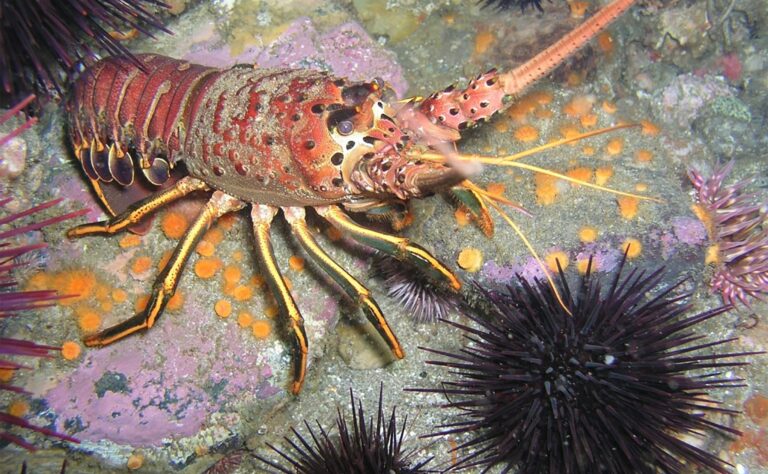
The tropical rock lobster, also called the ornate spiny lobster, is one of the most colourful lobsters in the sea. Its body is blue-green with a mottled pattern, and its legs are striped with bold bands of blue, yellow and black. It grows up to 20 inches (50 cm) long and 11 lbs (5 kg), making it one of the largest of the spiny lobsters.
Like all spiny lobsters it has no large claws. Two long, spiny antennae sweep ahead of it as it walks and can be swung at anything that comes too close.
Rock lobsters grow quickly for a lobster, reaching market size in two to three years, and females carry their orange eggs under the tail until they hatch.
Tropical rock lobsters live across the Indo-Pacific, from the Red Sea and East Africa through southeast Asia to northern Australia, Papua New Guinea and Fiji. They favour coral reefs, rocky areas and rubble bottoms in shallow water, usually less than 165 feet (50 m) deep, and often shelter in reef caves.
They come out at night to feed on snails, clams, crabs, sea urchins and worms, and scavenge dead animals. Shells are crushed with powerful jaws rather than claws.
Rock lobsters spend the day in dens and forage at night. Every year the lobsters of the Torres Strait between Australia and New Guinea make one of the longest known lobster migrations, walking hundreds of miles east across the sea floor to breed in the Gulf of Papua.
Like other spiny lobsters they can produce a loud rasping sound with their antennae when alarmed.
Panulirus ornatus belongs to the spiny lobster family Palinuridae. The IUCN lists it as Least Concern. It is an important catch for island communities in the Torres Strait and Papua New Guinea, and it is farmed in sea cages in Vietnam and Indonesia, where young lobsters caught from the wild are grown to market size.