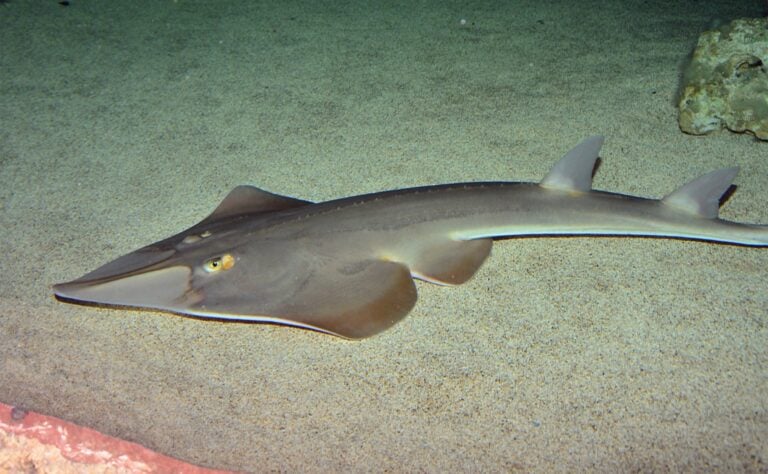
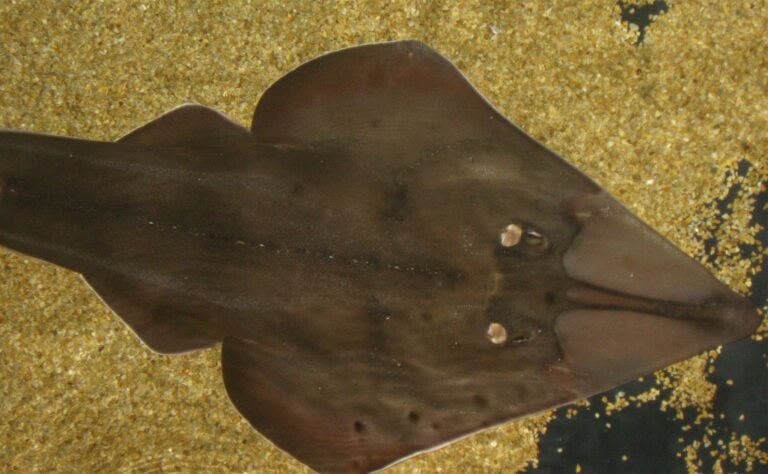
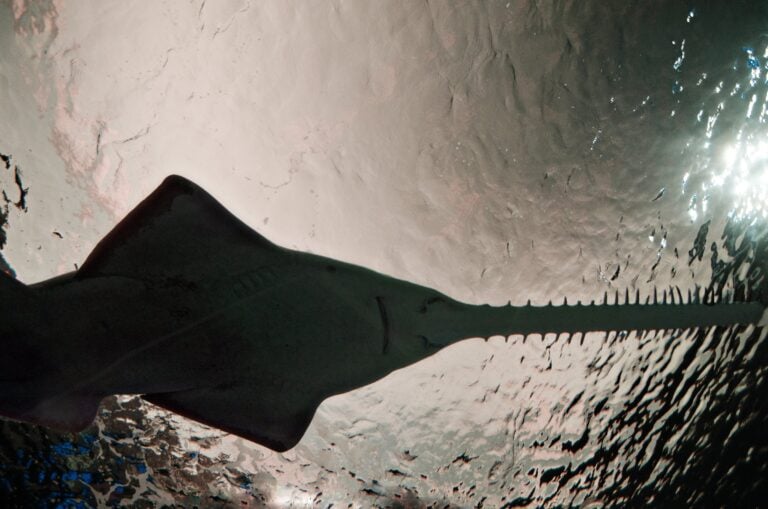
Banjo rays, also called fiddler rays, get their name from their shape: a rounded disc for a body and a thick, muscular tail that looks like the neck of a banjo. The southern fiddler ray pictured grows to about 4 feet (1.2 m) long and is sandy brown with bold dark stripes and triangles across its back, a pattern that breaks up its outline on the seabed.
Like guitarfish, banjo rays are halfway between a ray and a shark in build. They swim with sweeps of the tail rather than by flapping their fins, and they have no stinging spine.
Their small, flat teeth are built for crushing shellfish rather than cutting.
Banjo rays live in shallow coastal waters of southern Australia, from sandy bays and seagrass meadows down to about 600 feet (180 m). Related species live off the Pacific and Atlantic coasts of the Americas.
They are most often seen resting on sand or weed in sheltered bays and estuaries, where divers and snorkellers can approach them closely.
Banjo rays feed on the bottom, eating crabs, shrimp, worms, clams and small fish that they find with the electrical sensors on their snout and crush with their flat teeth.
They spend much of the day lying still on the seabed, often partly covered in sand, and become more active at dusk. They are slow swimmers and completely harmless to people.
Banjo rays give birth to live young. The eggs hatch inside the mother and four to six pups are born after about a year, each a miniature copy of the adult.
Banjo rays make up the family Trygonorrhinidae, with eight species in three genera: the fiddler rays of Australia and the banjo rays and shovelnose guitarfish of the Americas. The IUCN lists the southern fiddler ray (Trygonorrhina dumerilii) as Least Concern.
Their main pressure is being caught accidentally in trawl and gill nets, and some species with small ranges are considered at risk.