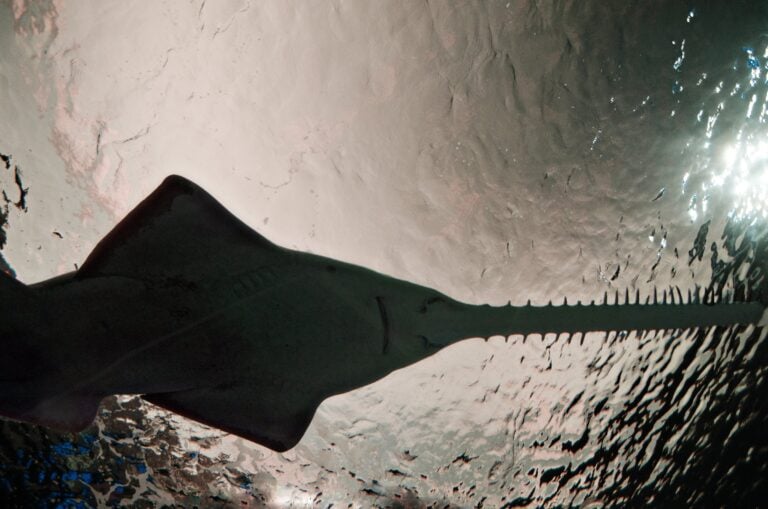
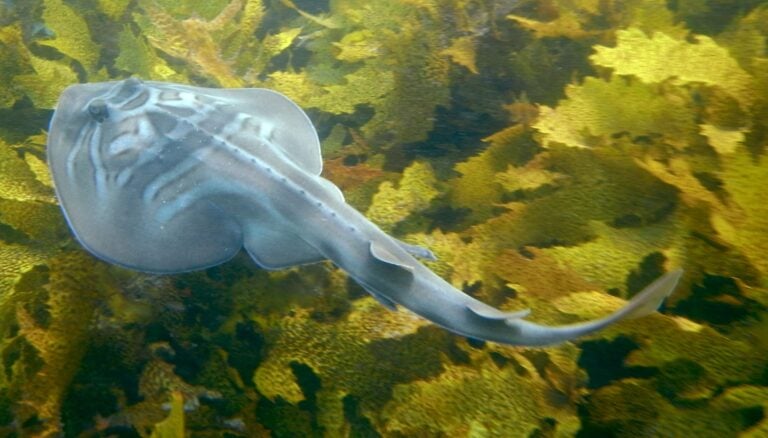
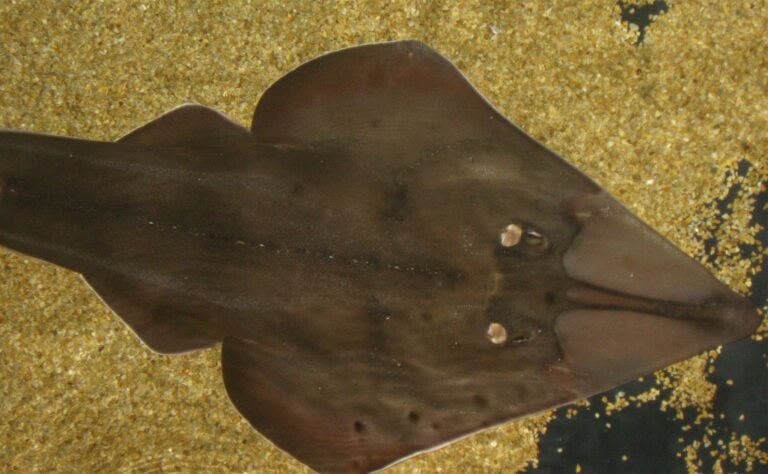
Wedgefish are large, shark-like rays with a pointed, wedge-shaped snout, tall dorsal fins and a powerful tail. The whitespotted wedgefish pictured grows to 10 feet (3 m) and 500 lbs (227 kg). Its grey-brown back is scattered with white spots, and a dark spot ringed with white sits on each shoulder.
Rows of thorns run along the back and around the eyes, and the mouth underneath the head holds a pavement of flat teeth for crushing shells. Wedgefish swim with their tails like sharks and are sometimes called shark rays.
Wedgefish live in warm coastal waters of the Indian Ocean and western Pacific, from the Red Sea and East Africa to Australia and Japan. They are found on sand and mud near reefs, in estuaries and along beaches, usually in water less than 230 feet (70 m) deep.
They eat crabs, lobsters, clams, squid and small fish taken from the seabed and crushed between their tooth plates.
Wedgefish rest on the bottom by day and forage at night, swimming slowly over the sand. They are shy and move away from divers.
Females give birth to four to ten live pups after a pregnancy of around a year, and the young take many years to mature.
The wedgefish family Rhinidae has ten species, including the bowmouth guitarfish. The IUCN lists nearly all of them as Critically Endangered, including the whitespotted wedgefish (Rhynchobatus djiddensis). Their fins fetch the highest prices of any in the shark fin trade, and they are easily caught in coastal nets. All wedgefish have been protected under international trade rules since 2019.