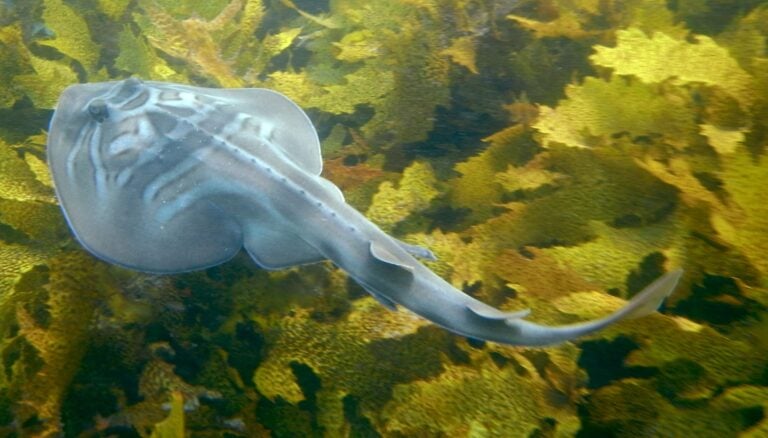
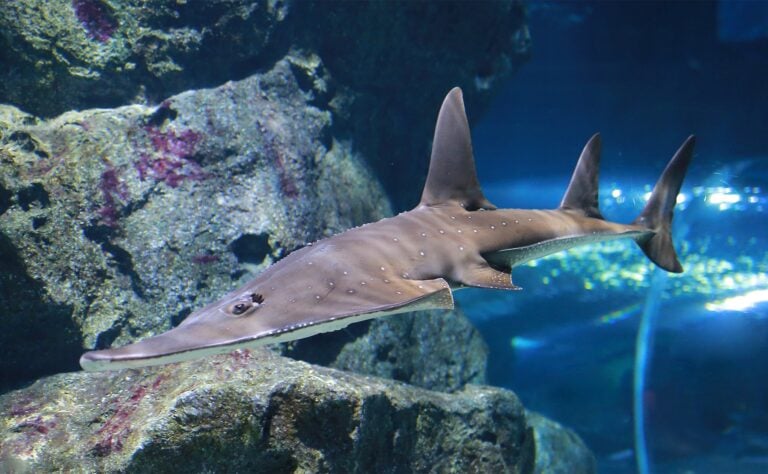
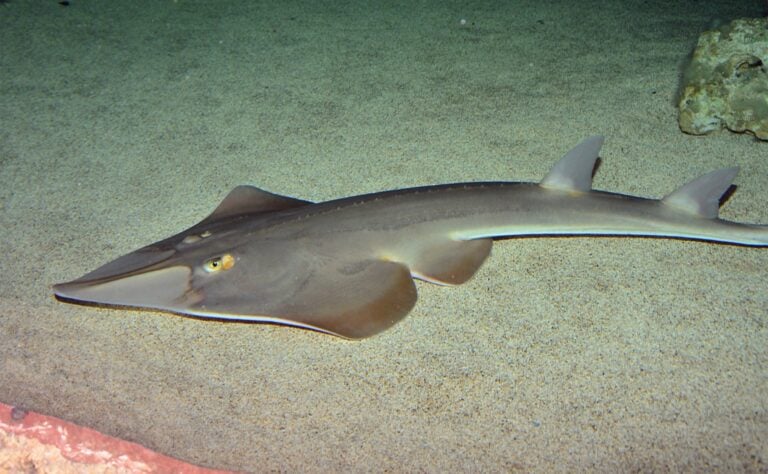
Giant guitarfish are the largest of the guitarfish, shark-like rays with a long, flattened, wedge-shaped head and a muscular tail with two tall dorsal fins. The blackchin guitarfish pictured reaches 8 feet (2.5 m), and the giant guitarfish of the Indian Ocean grows to 10 feet (3 m). The underside of the snout is dark, which gives the blackchin its name.
Their backs are sandy to olive brown, their eyes sit on top of the head and their small mouths are underneath, lined with rows of blunt teeth for crushing shells. Like sharks they swim with side-to-side sweeps of the tail.
Giant guitarfish live in warm coastal waters: the blackchin guitarfish in the eastern Atlantic from Portugal to Angola and in the Mediterranean, and its relatives across the Indian Ocean and western Pacific. They favour sandy bays, estuaries and seagrass beds from the shoreline down to about 330 feet (100 m).
They feed on the bottom, eating crabs, shrimp, clams, snails, worms and small fish, which they pin down with their snout and crush with their teeth.
Giant guitarfish spend much of the day resting half-buried in sand and become active at night. They are slow, unhurried swimmers and pose no danger to people.
Females give birth to live young, usually four to twelve pups, after a pregnancy of around a year.
The genus Glaucostegus holds six species of giant guitarfish. The IUCN lists all six as Critically Endangered, making them one of the most threatened families of fish in the sea. Their large fins are among the most valuable in the shark fin trade, and they are easily caught in coastal nets. Trade in all giant guitarfish has been regulated under CITES since 2019.