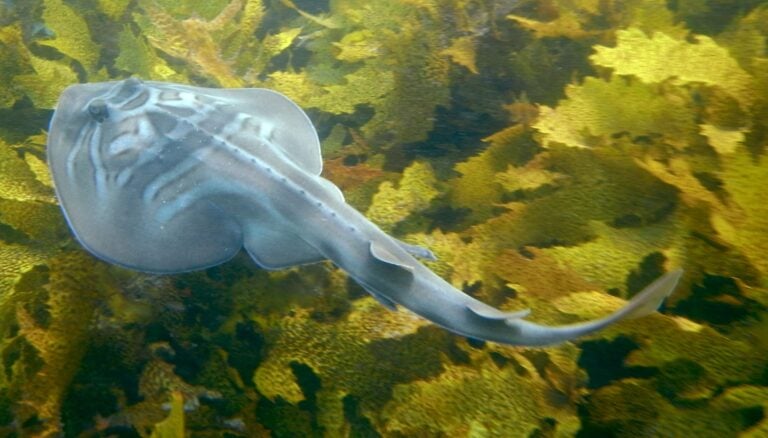
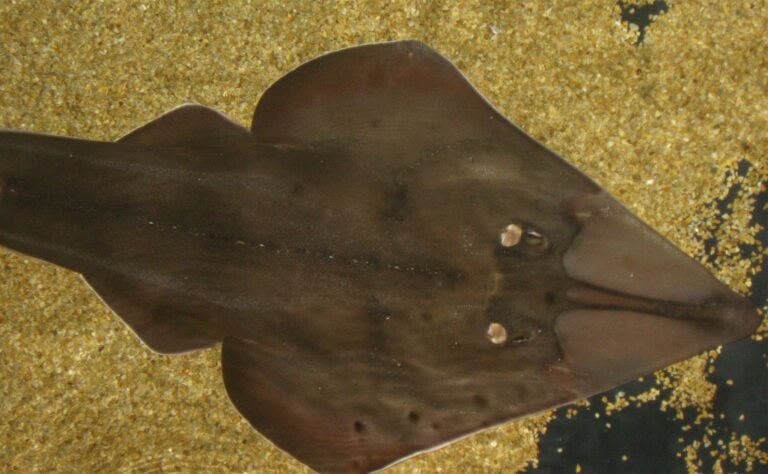
Guitarfish look like a cross between a shark and a ray, and that is roughly what they are. The front half is a flattened, triangular disc like a ray; the back half is a thick tail with two dorsal fins like a shark. The common guitarfish pictured grows to about 5 feet (1.5 m) and is sandy brown above and white below.
The eyes and breathing spiracles are on top of the head, and the mouth and gills are underneath. Rows of small, flat teeth form a crushing pavement for shellfish. Guitarfish have no stinging spine.
Guitarfish live in warm, shallow coastal waters around the world. The common guitarfish is found in the eastern Atlantic from the Bay of Biscay to Angola and throughout the Mediterranean, usually on sand and mud in bays, lagoons and estuaries in water less than 330 feet (100 m) deep.
They eat crabs, shrimp, clams, worms and small bottom-living fish, found by scent and by the electrical sensors around the snout, and crushed between their flat teeth.
Guitarfish rest on the bottom, often partly buried, and move off slowly when disturbed, swimming with the tail like a shark. They are more active at night.
Females give birth to live young, typically four to ten pups, after about a year.
The guitarfish family Rhinobatidae includes about 35 species. The IUCN lists the common guitarfish (Rhinobatos rhinobatos) as Critically Endangered after steep declines across the Mediterranean, where it was once abundant, and many relatives are in the same position. Coastal trawling and the fin trade are the main causes.