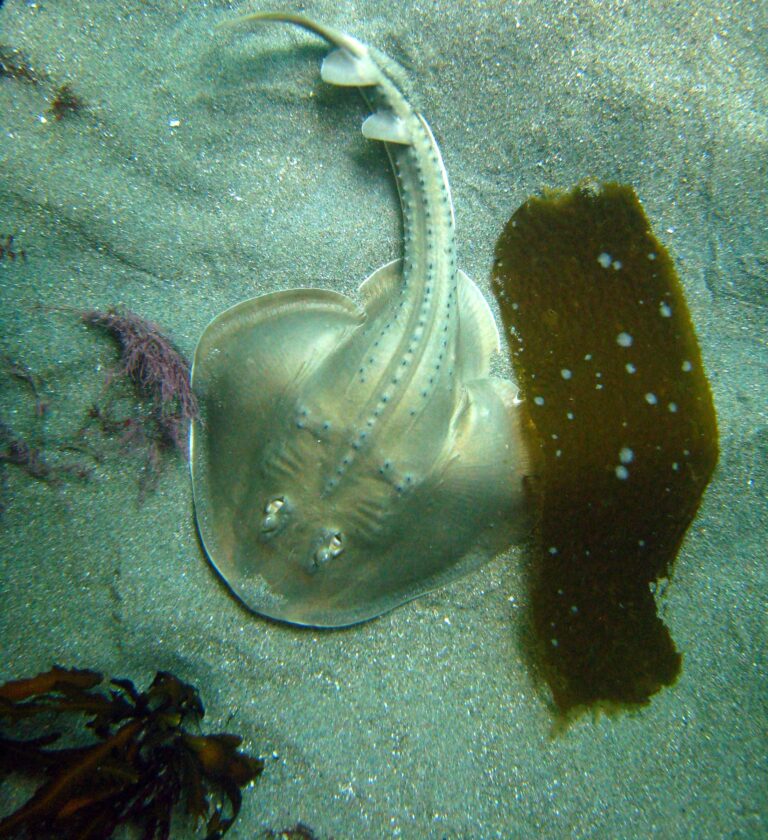
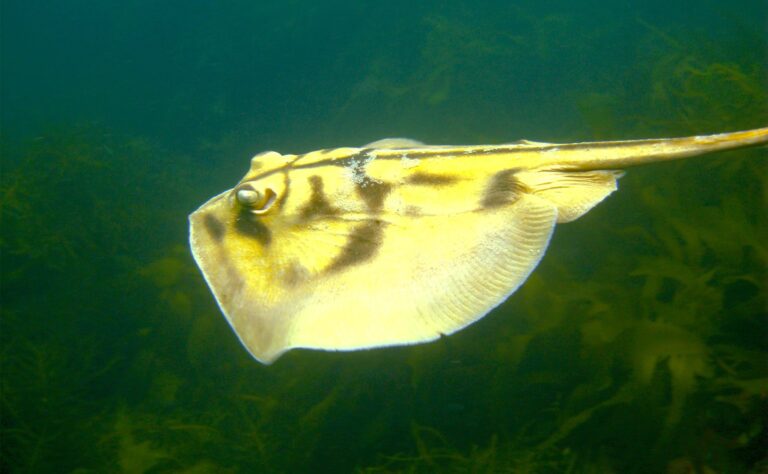
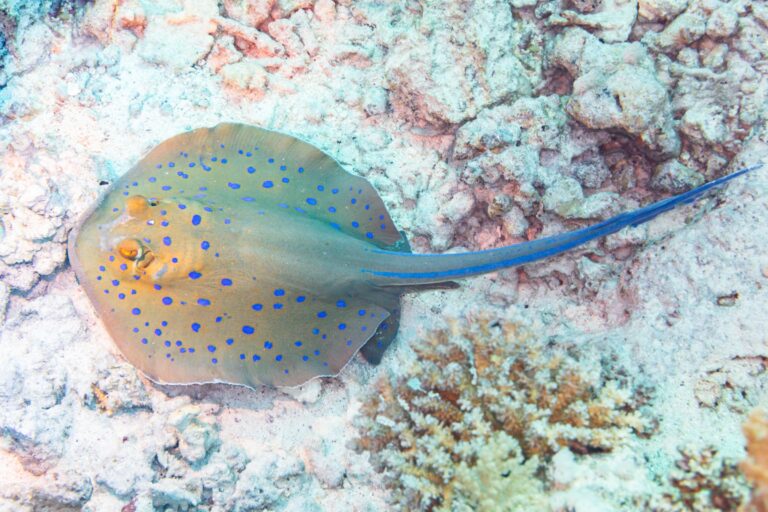
Butterfly rays are the widest of all rays for their length. The body disc is nearly twice as wide as it is long, with pointed wing tips and a tail so short it looks almost like an afterthought. The spiny butterfly ray pictured can span 8 feet (2.5 m) across, while other species are a quarter of that size.
Their backs are mottled brown, grey or olive with spots and squiggles that match the sand, and they can change their colour to suit the bottom. Most species have a small stinging spine on the tail, but it is short and rarely used.
Butterfly rays live in warm temperate and tropical seas on both sides of the Atlantic, in the Mediterranean and across the Indian and Pacific Oceans. They stay close to shore on sandy and muddy bottoms, often in estuaries and surf zones, usually in water less than 200 feet (60 m) deep.
They eat fish, shrimp, crabs, clams and worms, swooping down onto prey on the seabed or ambushing it from a layer of sand.
Butterfly rays spend the day buried in sand with their broad wings flattened against the bottom, and feed mostly at night. They swim with a rippling, almost fluttering motion that gave them their name.
Females give birth to live young, usually two to eight pups, after a pregnancy of several months.
The family Gymnuridae holds about a dozen species in a single genus, Gymnura. The IUCN lists the spiny butterfly ray (Gymnura altavela) as Endangered: it has vanished from much of the Mediterranean and the coasts of West Africa and Brazil because it is so easily caught in bottom trawls and gill nets.