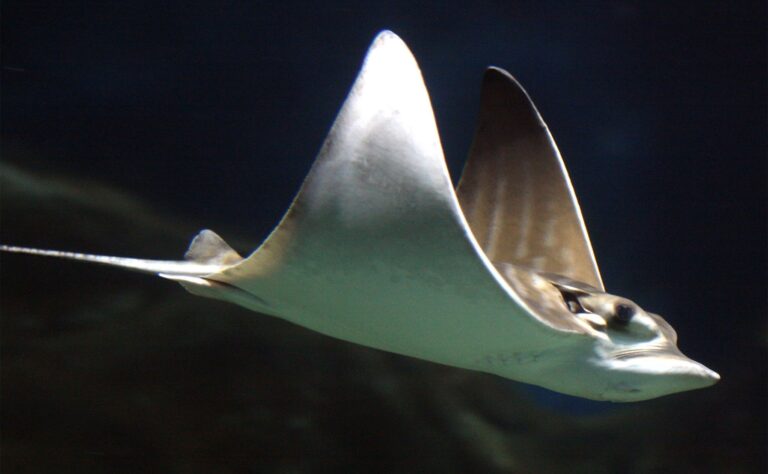
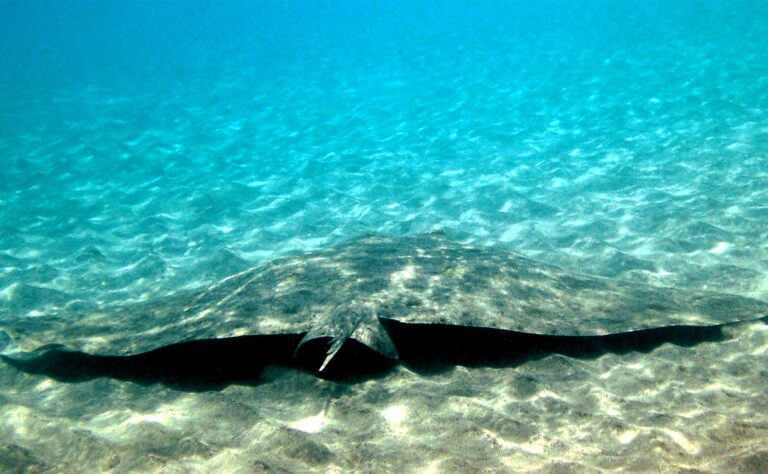
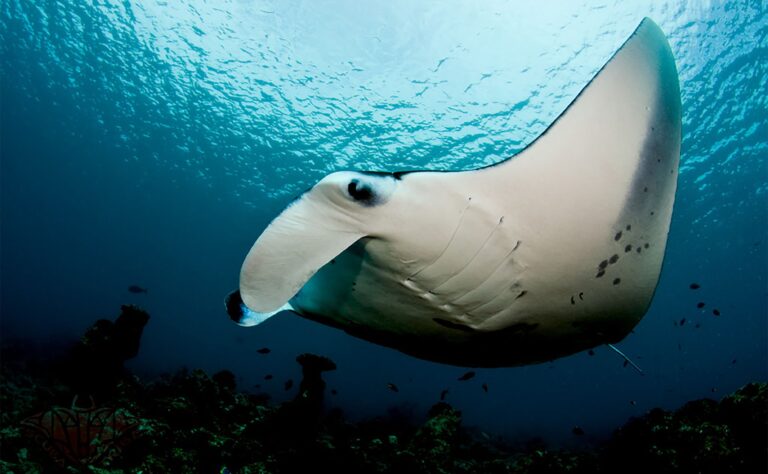
Stingarees are small, round stingrays of Australia and the western Pacific, most of them less than 2 feet (60 cm) long. The crossback stingaree pictured grows to about 20 inches (50 cm) and is named for the dark cross pattern on its yellowish-brown back.
Unlike the long whip tails of their larger cousins, stingarees have a short, thick tail that ends in a leaf-shaped fin, with one or two venomous spines partway along it. Their discs are smooth and almost circular, and their small eyes are followed by large spiracles for breathing when buried.
Stingarees live in temperate and tropical coastal waters, with the greatest number of species around southern Australia. The crossback stingaree is found off south-eastern Australia and Tasmania, on sand and mud in bays, estuaries and offshore down to about 690 feet (210 m).
They eat worms, shrimp, small crabs and occasionally small fish, which they dig out of the sand and crush with rows of small flat teeth.
Stingarees spend the day resting on the bottom, often half-buried, and feed at night. They are placid animals but will sting if stepped on or handled, and their venom is painful.
Females give birth to one to four live pups after a pregnancy of several months. Unusually for a ray, the mother feeds the developing young with a rich fluid called uterine milk.
The stingaree family Urolophidae has about 30 species. The IUCN lists the crossback stingaree (Urolophus cruciatus) as Least Concern, but several of its relatives with small ranges, such as the Kapala stingaree of New South Wales, are Endangered because of trawling.