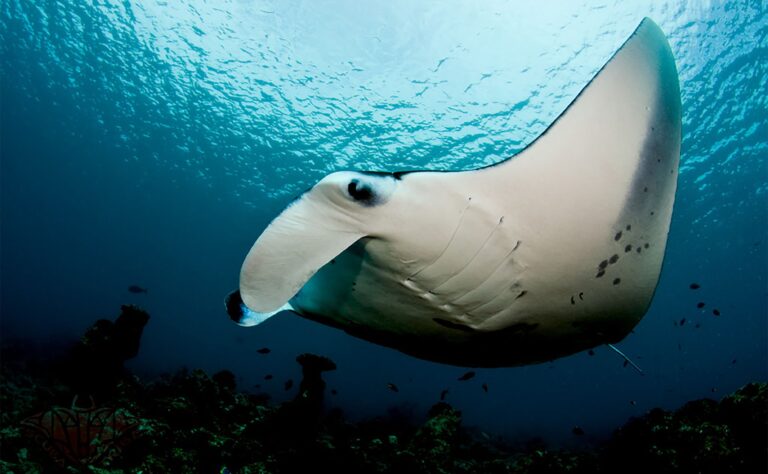
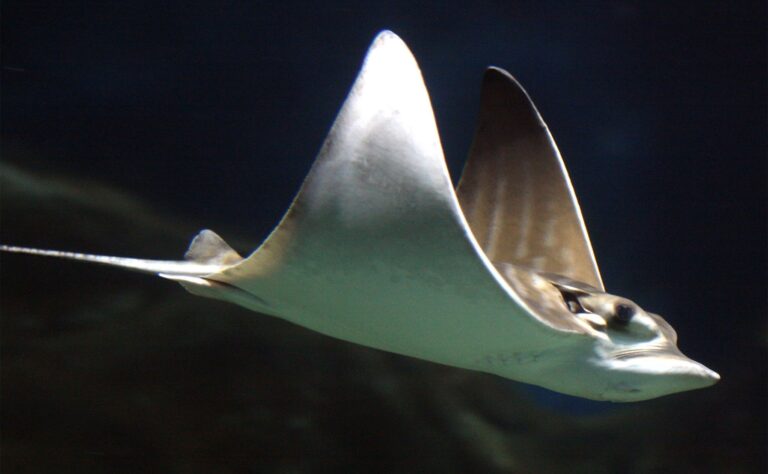
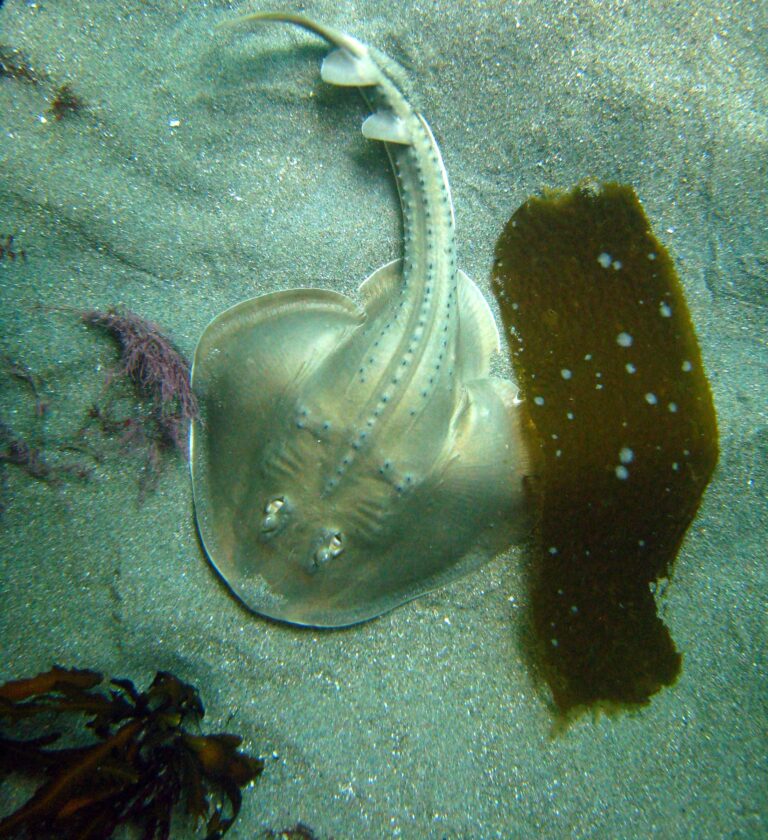
Whiptail stingrays are the classic stingrays: a flat, rounded or diamond-shaped disc and a long, thin tail armed with one or two serrated, venomous spines. The family ranges from the blue-spotted ribbontail ray pictured, a reef beauty just 14 inches (35 cm) across, to the giant freshwater stingray of Southeast Asia, which can reach 16 feet (5 m) long and 660 lbs (300 kg), the largest freshwater fish in the world.
The eyes sit on top of the head and the mouth beneath, with flat teeth for crushing shells. Pores around the snout sense the faint electric fields of buried animals. The tail spine is a defensive weapon that is only used when the ray is trapped or stepped on.
Whiptail stingrays live in tropical and warm temperate seas around the world and in many tropical rivers. The blue-spotted ribbontail ray lives on coral reefs of the Indian and Pacific Oceans, sheltering in caves and under ledges and moving onto sand flats with the rising tide to feed.
They eat worms, shrimp, crabs, clams and small fish, found with their electrical sense and dug out of the sand. Feeding rays leave rows of shallow pits across sand flats.
Stingrays spend much of their time resting on the bottom, often covered with a dusting of sand. They are calm and curious animals, and in a few places, such as Stingray City in the Cayman Islands, they gather to be fed by swimmers.
Females give birth to live young, usually one to seven pups. Stingrays only sting in self-defence, but their venom is extremely painful.
The whiptail stingray family Dasyatidae contains about 100 species, including the southern stingray, the short-tail stingray and the giant freshwater stingray. The IUCN lists the blue-spotted ribbontail ray (Taeniura lymma) as Least Concern, but around a third of the family is threatened by coastal fishing, reef damage and, for the ribbontail, collection for the aquarium trade.