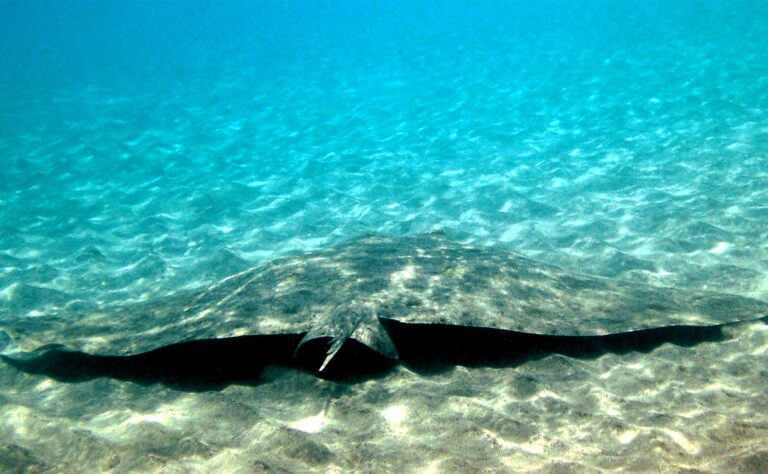
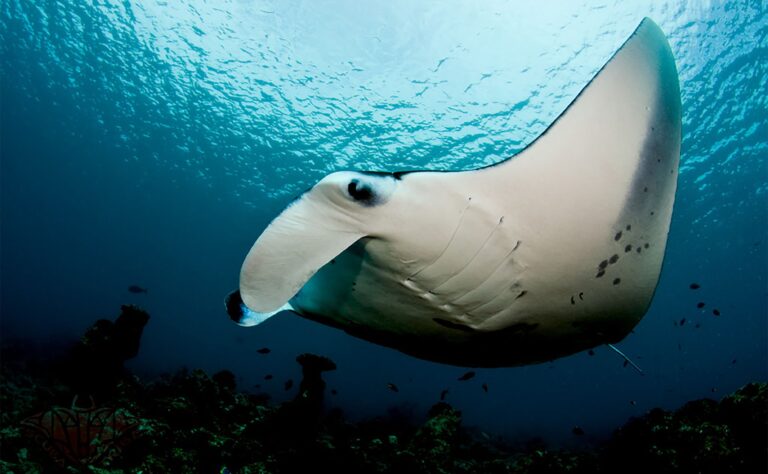
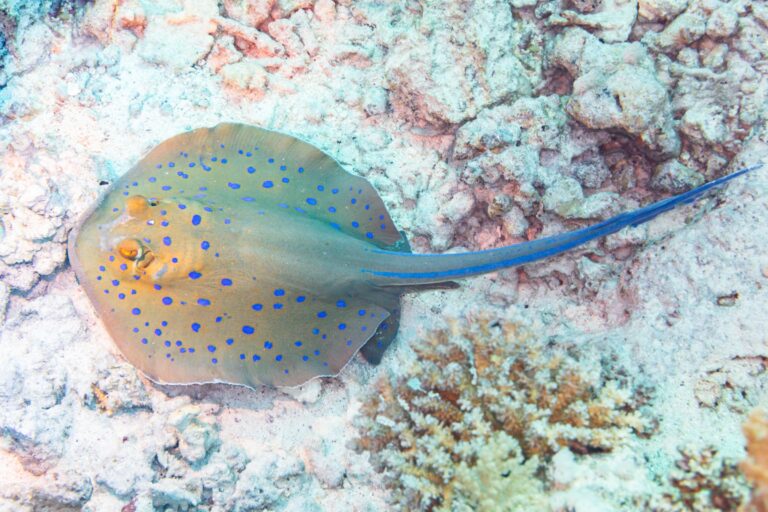
Eagle rays are the fliers of the ray world, with long, pointed wings that they flap like a bird rather than ripple like a stingray. The spotted eagle ray can span 10 feet (3 m) and weigh 500 lbs (230 kg), and its whip-like tail can be two or three times the length of its body. The bull ray pictured, a Mediterranean and East Atlantic species, reaches a similar size.
Eagle rays have a raised head with large eyes and a snout shaped like a duck's bill, which they use to dig in the sand. Their mouths hold flat plates of teeth for crushing shells. One or more venomous spines sit at the base of the tail.
Eagle rays live in tropical and warm temperate seas around the world, from coral reefs and shallow bays to the open ocean. Unlike most rays they spend much of their time swimming in midwater rather than lying on the bottom.
Many species are nomadic, travelling long distances along coasts and between islands.
Eagle rays dig clams, oysters, crabs, shrimp and sea snails out of the sand with their snouts and crush them between their tooth plates, spitting out the shell fragments. They also take small fish and squid.
Eagle rays are famous for leaping clear of the water, sometimes several times in a row, possibly to shake off parasites or to signal to each other. They often travel in schools of dozens or even hundreds, gliding in formation.
Females give birth to one to four live pups after a pregnancy of about a year.
The eagle ray family Myliobatidae includes the spotted eagle ray, the bull ray, the bat ray of California and the cownose rays. Many are in serious decline: the IUCN lists the spotted eagle ray (Aetobatus narinari) as Endangered and the bull ray (Aetomylaeus bovinus) as Critically Endangered, mostly because they are so easily caught in coastal nets and breed so slowly.