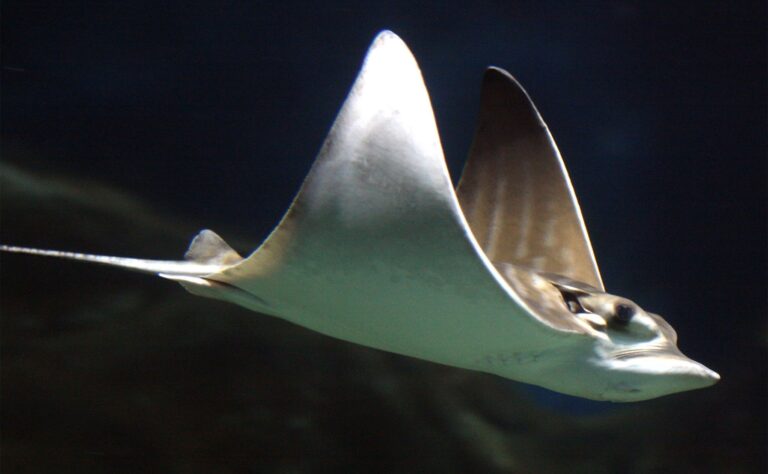
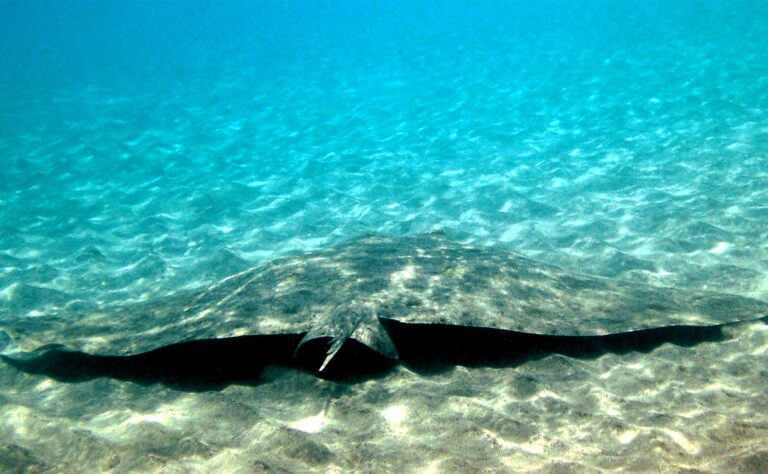
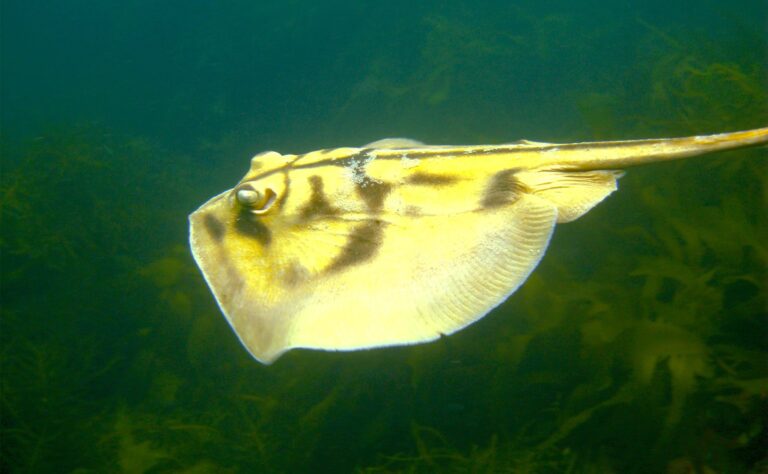
Thornback rays are a small family of rays that look like a stingray at the front and a guitarfish at the back: a rounded, heart-shaped disc followed by a thick tail with two dorsal fins. The thornback guitarfish pictured, found off California, grows to about 3 feet (91 cm) long.
Their name comes from three rows of large, hooked thorns that run down the middle of the back and along the tail. Despite the fierce look, thornback rays have no stinging spine and are harmless. Their backs are olive to brown, their bellies white, and their small mouths hold rows of tiny teeth for gripping small prey.
The thornback guitarfish lives in the eastern Pacific from San Francisco Bay south to Baja California, in sandy bays, kelp beds and off beaches from the shallows down to about 450 feet (137 m). Its relatives, the fanrays, live in the coastal waters of eastern Asia.
Thornback rays eat crabs, shrimp, worms, clams and small fish, which they find in the sand with their electrical sense and suck into their small mouths.
They spend much of their time buried in sand on the bottom. In summer thornback guitarfish gather in groups in shallow bays, probably to mate, and are a familiar sight to divers and surfers in southern California.
Females give birth to live young, from one to fifteen pups, in late summer.
The thornback ray family Platyrhinidae has five species: the thornback guitarfish (Platyrhinoidis triseriata) of the American Pacific and four fanrays (Platyrhina) in Asia. The IUCN lists the thornback guitarfish as Least Concern, while the Asian fanrays are Vulnerable or Endangered because of heavy coastal fishing.